


3 appointments from 3,000 texts. Then 36 appointments in two days from the same dead list. Here’s what changed in between…
If you run an agency on HighLevel, you’ve probably had some version of this thought: I already pay for this platform. It has AI built in. Why would I add another tool?
It’s a fair question, and it deserves a better answer than “because ours is better.” So we sat down with Ari, an agency owner who’s been building on CloseBot since V1, back when it was still stitched together with Zapier, and asked him directly.
His answer was all about the results.
From nursing to 40 leads a day
Ari didn’t come from marketing. He came from nursing, taught himself the online side by watching YouTube, and started picking up freelance work that gradually turned into clients. His first real client was a relative who called him in a panic after her marketing guy disappeared.
He fixed the top of the funnel fast. Ads started producing. And then he hit the bottleneck many agencies hit…
“Everything is flowing, but no one answers phone calls.”
The client was a pen-and-paper business owner. Ari hired a VA. The VA could only handle so much. Leads were arriving faster than anyone could respond to them, and the ones who didn’t get a fast answer just evaporated.
That’s the gap he brought CloseBot in to fill:
“AI cannot and should not replace a human 100%. But it can definitely do a lot of the heavy lifting that humans are missing.”
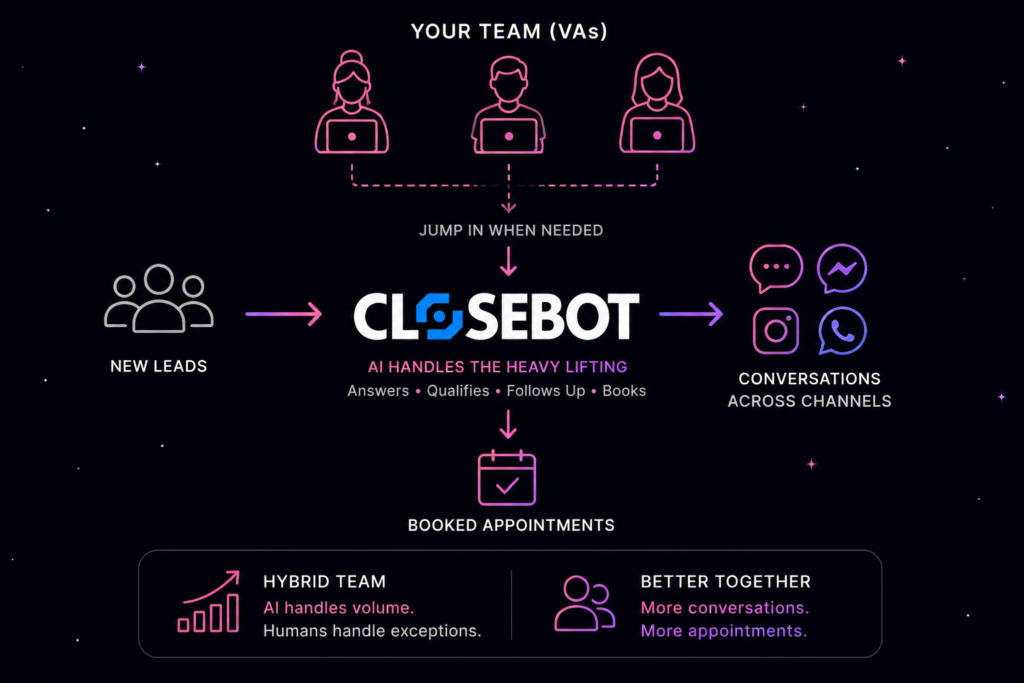
That framing matters for what follows. Ari isn’t running an unattended robot. He’s running three VAs and one AI agent, with clear rules about which one handles what.
The number: 3 versus 36
The clearest before-and-after came from a database reactivation on a small mother-and-daughter beauty salon… a client he took on as a favor.
Round one, workflows only. Ari built the campaign the conventional way: a text blast to roughly 3,000 dormant contacts, scheduled follow-ups, and a human reading the replies. The result was 3 appointments. He also had to sit and book every one of them by hand.
“That proved to be a total fail… Three. I’m like, you know what, this is not working.”
Round two, same list, conversational AI handling the replies. He rebuilt the campaign with a CloseBot agent running the conversations end to end answering questions, handling objections, following up, and booking directly to the calendar.
36 appointments in two days. Then more over the weekend, and 12 more by noon the following Saturday on a subsequent round.
The list wasn’t cleaned. There were wrong numbers and hard nos in it. And there was no promotion attached.
“That was just mind-opening. I’m like, that’s the difference? Like 10X?”
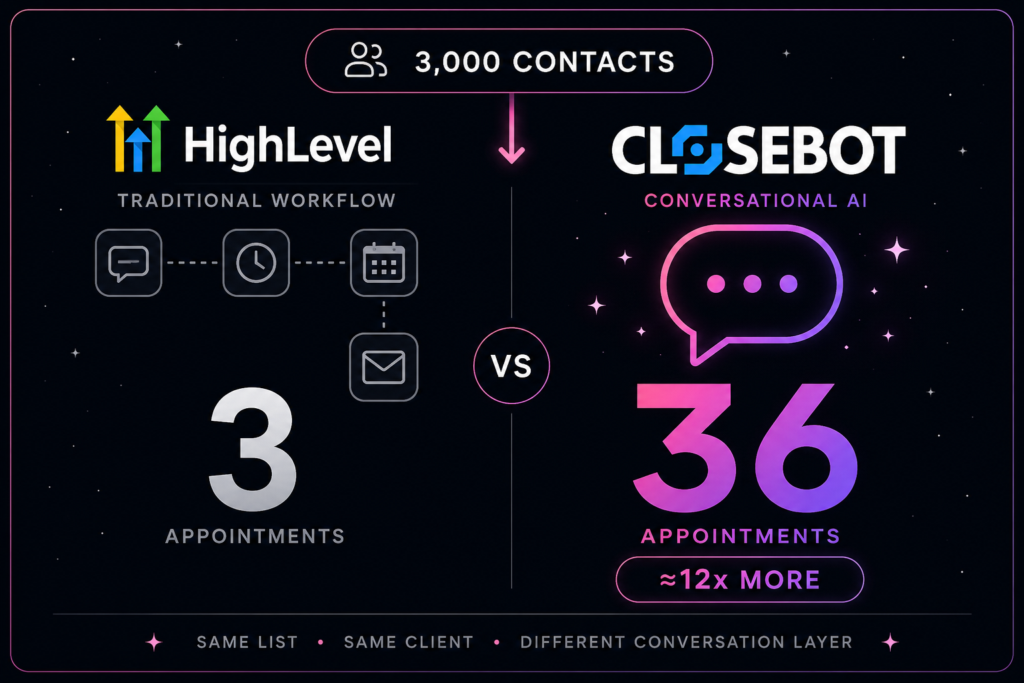
At an average ticket of roughly $200, Ari estimates he generated about $7,000 in business for a client who had been on the fence about working with him at all.
One thing worth being precise about, because it’s the part that actually transfers: round one wasn’t a failure of HighLevel’s AI. Round one had no conversational AI in it at all. It was scheduled messages and a human, which is exactly how most database reactivations still get run, inside HighLevel and everywhere else. The 10x didn’t come from swapping platforms. It came from putting a real conversation in the gap where a scheduled message used to sit.
If you want the mechanics of setting one of these up, we broke down our own reactivation campaign with the raw numbers in Reactivate Your Database: AI Appointment Setter Strategies, and Shawn Armstrong’s agency ran a similar play on a financial services client in How One Agency Booked Dormant Leads in 4 Hours.
“It’s another layer”: the honest case for a specialist
So why not use HighLevel’s native Conversation AI, which Ari already has access to?
His answer was blunt but not hostile:
“I didn’t dive too much into HighLevel because I started seeing it’s just another layer, another feature. It can’t replace someone who’s been doing this A to Z, with an entire business built on it.”
And the reasoning underneath it:
“When you’re trying to be good at everything, you end up being the master of none. AI communication with a customer is too important to me… I want to give it to the people who are perfecting it.”
Here’s the part that surprises people: HighLevel largely agrees with this, and says so publicly.
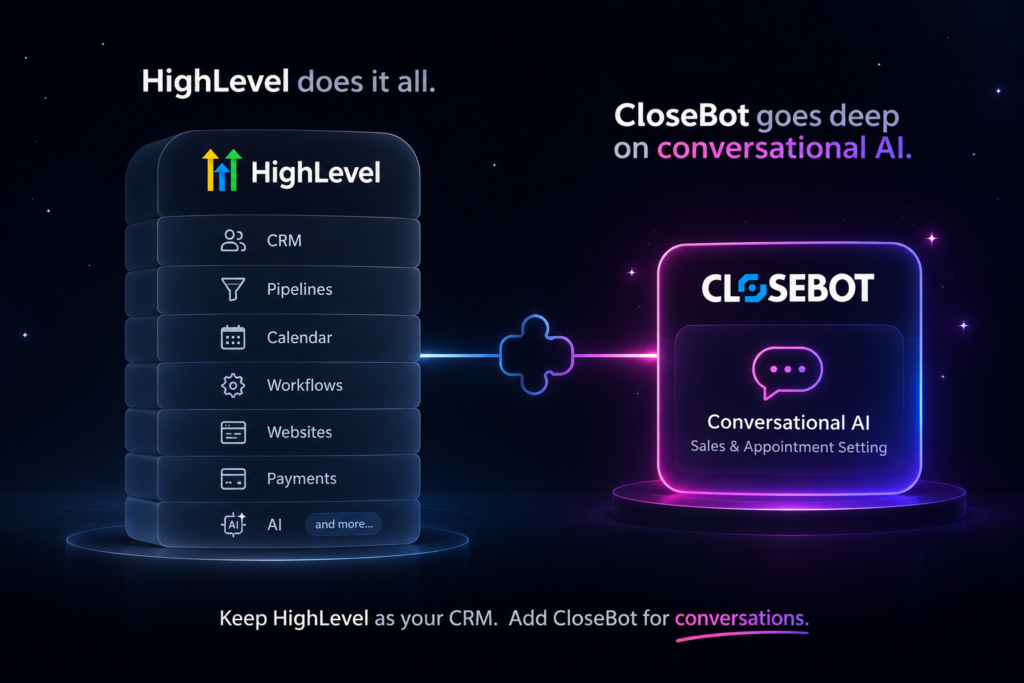
In a conversation between HighLevel CTO and co-founder Varun Vairavan and CloseBot’s Bryce DeCora, Varun described how HighLevel decides what to build. If roughly 80% of users need a feature to be convinced to sign up, HighLevel builds it. If 20% or fewer need it, that’s what the marketplace is for. Baseline conversational AI is table stakes for a CRM in 2026… of course HighLevel ships it. But deep conversational intelligence, industry-specific reasoning, and agents that genuinely replace a role are not 80% problems. They’re specialist problems. We wrote that conversation up in full in HighLevel, Conversational AI, Marketplaces and the Rise of the AI Employee.
So “HighLevel vs CloseBot” is a slightly misleading way to frame the decision. CloseBot runs on HighLevel. Your CRM stays your CRM, your calendars, your pipelines, your workflows, your sub-accounts. The question isn’t which platform wins. It’s whether the conversation layer sitting on top of your CRM is something you want handled by a feature or by a company whose entire existence depends on it.
If you want the granular version of that comparison, we’ve published it three ways: pricing and plan math, side-by-side conversation quality, and 13 specific capability differences.
What “specialized” looks like on a Tuesday
Ari’s day-to-day makes the abstraction concrete. Three things he keeps coming back to:
Follow-up that doesn’t quit
This is his number one. Ask a business owner whether they follow up with no-shows and cancellations and they’ll say yes. Watch what actually happens and it’s one message, maybe two.
“As much as you’re going to instruct a human, they’re not going to do that follow-up. They’ll do it maybe once or twice, and it’s gone.”
Worse is the scheduled-message approach, the “I’m in the hospital, reach out after the holidays” lead who gets an automated text two weeks later. In Ari’s words, that one goes “into the void,” because a scheduled broadcast isn’t a conversation and people don’t answer it.
A CloseBot agent picks the thread back up where it left off, in context, weeks later, and keeps going until there’s an outcome. More on why that beats a workflow in Why Smart Agencies Are Ditching Native AI for Specialized Sales AI.
Every channel, because SMS is getting harder
Ari flagged something a lot of agencies are feeling right now: iPhone message filtering is quietly doing to SMS what the Promotions tab did to email. Response rates on text are sliding.
“The fact that CloseBot can respond on Instagram, Facebook, WhatsApp is a huge plus, because right now even SMS is becoming obsolete.”
His newest client is almost entirely Instagram, Facebook, and WhatsApp. Ari’s involvement is checking in once a day to see what needs manual review, which he says isn’t much.
Handoff on uncertainty
The rule he built: the moment the agent hits a gray area, it pings a VA and steps back.
That single design choice is why he trusts it on real client revenue. It isn’t set-and-forget; it’s a bot that knows the edge of its competence and hands the conversation to a human before it does damage. Our Agent Node architecture exists precisely so agencies can get flexible reasoning without giving up those guardrails.
The staffing mat
Ari currently runs three VAs and one CloseBot agent across his accounts.
“I don’t think even 10 of them would be doing the same volume CloseBot is doing.”
The volume he’s talking about: 30–40 new leads a day on his highest-traffic account, 4–6 booked appointments a day on average, up to 10 on good days, and 24 in a single day after a text blast… a number he messaged us about because he didn’t believe it.
Notably, he puts the booking split at roughly 50/50 between the AI and his VAs on phone calls, partly because his demographic skews older and many of those leads simply prefer a call. That’s not a weaker result. That’s what a working hybrid looks like, and it’s the same pattern we found in our own study on AI versus human appointment setters.
Who this is actually for
Ari’s own advice, unprompted, was refreshingly narrow:
“It may not be for everybody. If you have a database of 10 people, sure, pick up the phone and do it yourself. This is for people who already have a list, or already have leads coming in.”
For everyone else, Ari’s version of the pitch is hard to improve on:
“I literally took a dead list and made something out of it. I didn’t see it until I tried it myself, and now I’m a believer.”
Already comparing options? Start with the pricing breakdown… for most agencies, CloseBot comes out cheaper than HighLevel’s native AI once you pass four sub-accounts.
You don’t need to replace HighLevel. CloseBot runs on top of it. HighLevel remains your CRM, calendars, pipelines, and workflows; CloseBot handles the conversation layer that sits above them. Agencies typically add CloseBot when native Conversation AI isn’t producing the reply quality or follow-up persistence they need on revenue-critical client accounts, not because they want to leave the platform.
They’re built for different jobs. HighLevel’s native AI is designed to cover the baseline conversational needs of the majority of its user base, which is the correct decision for a platform serving hundreds of thousands of accounts. CloseBot is a specialist tool built solely for lead qualification and appointment booking, with deeper conversation control, multi-agent routing, cross-channel handling, and long-horizon follow-up. HighLevel CTO Varun Vairavan has described this split directly: features roughly 80% of users need get built in-house, and the remaining 20% are what the marketplace exists to solve.
For most agencies, yes, once you pass about four sub-accounts. CloseBot bills usage per sub-account rather than as a flat unlimited add-on, and that usage is re-billable to your clients. Below four sub-accounts the native option is often the cheaper choice. Current plan pricing for both is worth checking directly, since it changes.
In this case study, a 3,000-contact dormant list produced 3 appointments when run through scheduled text workflows with a human reading replies, and 36 appointments in two days when the same list was re-run with a CloseBot agent handling the conversations, roughly a 10x difference. The list was uncleaned and no discount or promotional offer was attached. Results vary by industry, list age, and offer, but a 1% or better booking rate on a dormant database is a realistic benchmark for conversational AI.
The most common cause is that the campaign was built from scheduled messages rather than conversations. A broadcast plus timed follow-ups can only send; it can’t answer “how much is it,” handle an objection, or pick a thread back up three weeks after someone says “not until after the holidays.” Those replies need a human to catch them, and at any real volume they don’t get caught. Adding a conversational agent that responds in context and follows up indefinitely is usually what turns a flat reactivation around.
No. The strongest setups run both. The agency owner in this case study runs three VAs alongside one CloseBot agent, with the agent configured to escalate to a human the moment it hits a question it isn’t confident about. His booked appointments split roughly 50/50 between the AI and his VAs, partly because his client base skews older and many of those leads prefer a phone call. The AI absorbs volume, speed-to-lead, and repetitive follow-up; humans handle judgment calls and relationship work.
Yes. CloseBot handles text-based channels including SMS, live chat, Instagram, Facebook Messenger, and WhatsApp, and can route different agents to different channels. This matters more each year: iPhone message filtering is pushing marketing SMS into a separate inbox the same way Gmail’s Promotions tab did to email, so single-channel SMS strategies are seeing response rates decline.