


Search for advice on running an AI booking bot and you will find a lot of confident numbers with nothing behind them. Respond in five minutes. Follow up seven times. Text beats email.
Some of it comes from a handful of accounts in a single niche. Some of it looks invented. Almost none of it comes with a sample size.
We had another option. CloseBot agents have now booked more than 1.1 million appointments across agencies, real estate teams, home service companies, healthcare practices, e-commerce brands and more. So instead of repeating the folklore, we went and looked at what the data actually says.
The short version: the appointments you’re missing out on are in the hours your team isn’t around…

Half of all bookings happen when nobody is working
Just over half of bookings land outside of business hours (9 to 5), measured in the lead’s own local time. A third arrive at 5:00pm or later.
The number that surprised us most: 11% land between midnight and 6:00am. That is roughly the same share of bookings that the entire day of Saturday produces.
If your AI booking bot runs on business hours, or hands after-hours leads to a form and a promise to call tomorrow, that is the half of the market it never competes for. And if you don’t reply, they are going to a competitor.
Note: This is especially impressive considering a lot of our users do database reactivations purely during business hours for compliance reasons… we expected most appointments to be booked during business hours for this reason. It looks like the weight of those who wait to contact you or even reply to database reactivation outreach after hours outweighs those who do so during business hours.
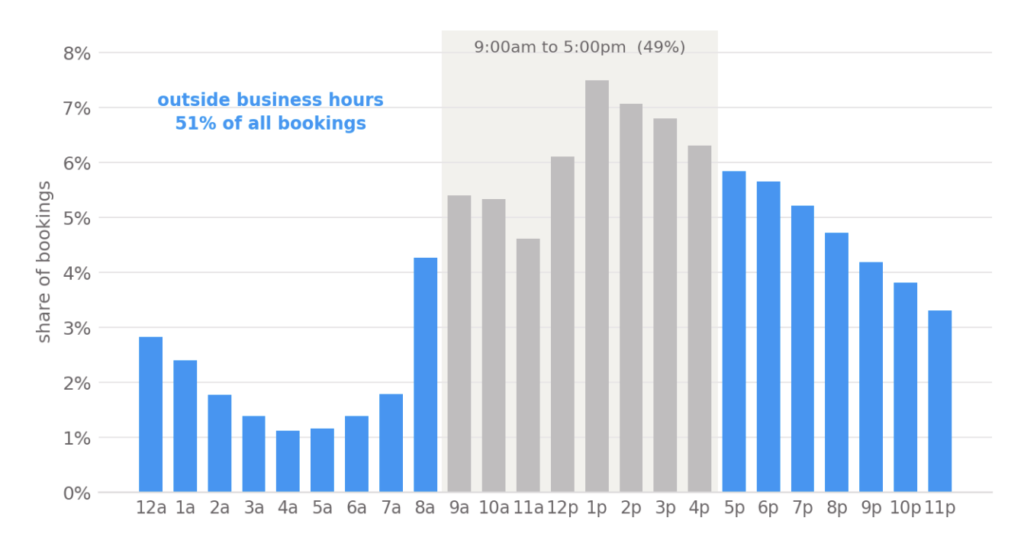
Why this matters: a business that restricts its AI to business hours, or routes after-hours leads to a form and a promise to call back tomorrow, is competing for roughly half the bookings available to it.
The quietest days of the week are the most efficient days (weekend)
Sunday produces the fewest bookings of any day. It also produces each one with the fewest messages, by a wide margin. Leads that are replying on Sundays are the ones who want to be there. They aren’t there to waste time, they are there to book; and if they don’t get a reply, they are going to a competitor.
Friday, a day most sales teams are still fully staffed for, is the worst performer on that measure. The gap between the two is larger than anyone on our team guessed before we ran the query.
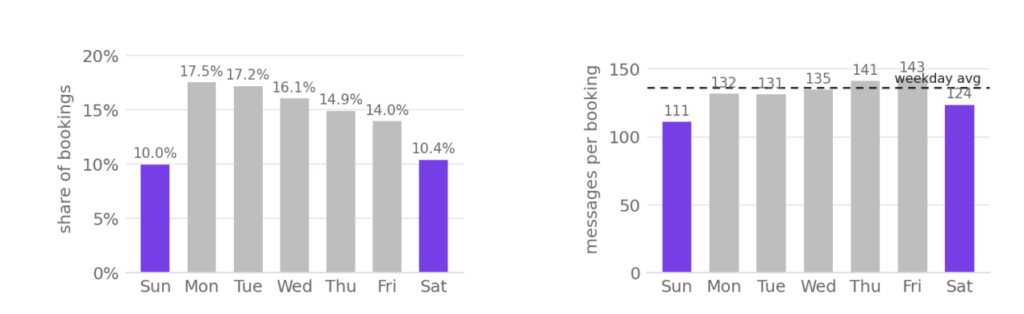
Monday through Wednesday carries 50.8% of all bookings, so the weekday peak is real. But the weekend’s 20.4% closes with the least effort in the week: a Friday booking takes. 29% more messages than a Sunday one, and weekends as a whole convert with 14% fewer messages than weekdays.
Keep in mind the number of messages per booking includes those who are disqualified and/or never end up booking. It makes sense that those messaging with you on their days off are the most motivated to convert.
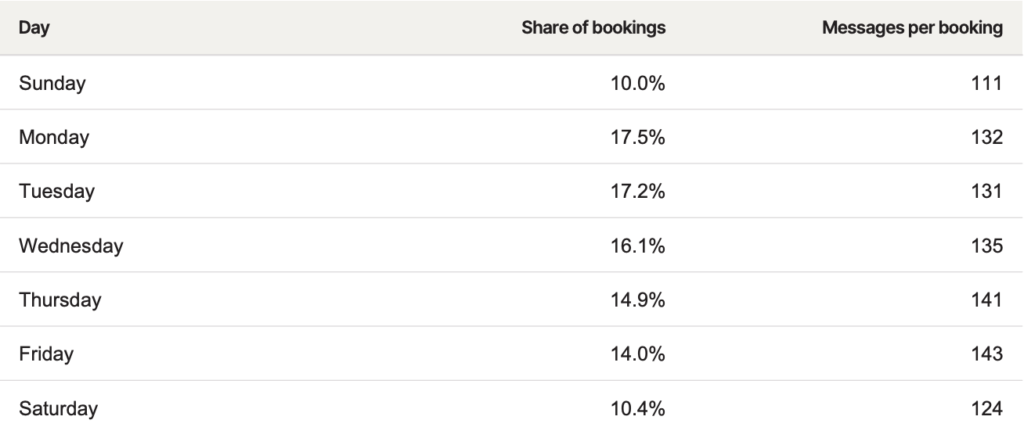
Why this matters: Sunday is the lowest volume day and the most efficient one. The explanation is likely intent: someone engaging at 9:00pm on a Sunday wants to be there. Weekend leads are the best traffic in the week, and the most likely to hit an empty inbox.
SMS Carried the Load
An important caveat. This chart measures volume, and volume alone. It reflects where conversations happen on our platform, and our base skews heavily toward SMS-first workflows. It does not prove SMS converts better per conversation.
About 12% of bookings involve a lead contacted or replying on more than one channel before booking. Meanwhile Facebook, Instagram, and live chat together hold just 4.2% of last-touch credit. The cross-channel population is roughly 2.9 times larger than the entire last-touch footprint of every social and chat channel combined.
Because cross-channel conversations tend to finish on SMS, the channel that closes takes the credit and the channel that opened the conversation vanishes from the chart above. A last-touch view is the wrong number to defund a channel on.
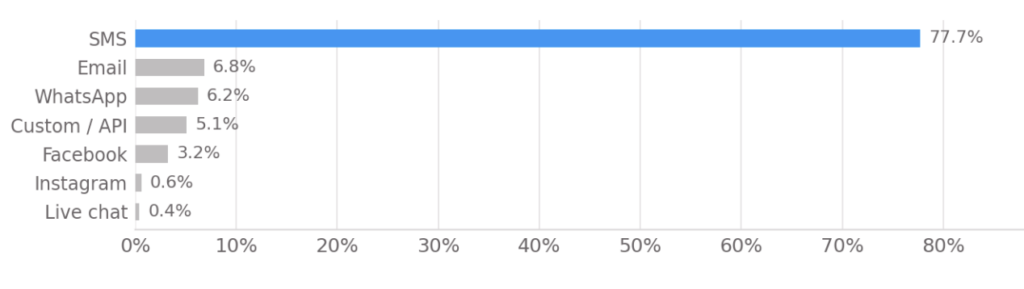
Why this matters: if your AI treats each channel as a separate conversation with a separate history, you are making one lead in eight repeat themselves, which is the fastest way to lose a warm one. At that rate, unified conversation state belongs in the base product.
One lead booked 355 days after first contact
Not 35 days. 355.
First message in early August. Booked appointment the following July, from an automated follow-up sequence that never gave up on them.
Every default follow-up window we have seen an agency configure expires long before then.
Why we bothered publishing it
Most of the sales AI category is busy shipping the next feature. It is the same pattern we broke down in our HighLevel Conversation AI comparison, where the native tooling keeps getting rebuilt across versions instead of getting better at the job.
We think there is a research problem underneath it: everyone is working from assumptions, and almost nobody has the volume required to stop.
We have the volume. Publishing it seemed more useful than another opinion post.
That includes publishing the parts that are inconvenient. The report says plainly where our channel data is skewed by our own customer base, where a figure is derived rather than directly measured, and where a number is an approximation. Clean numbers nobody can interrogate are worth less than honest numbers with the caveats attached.
If you are building on an AI booking bot for clients, or running one on your own pipeline, the report is the closest thing to a benchmark the category currently has.
Numbers to Quote Your Clients
Expect roughly 132 messages per booking. That is the booking-weighted average across the week, counting inbound messages and leads who never respond. Multiply it by your per-segment SMS cost before you quote. Most agencies underestimate it by modelling on the converting leads and forget the rest of the list.
Budget for 24/7 coverage from day one. A 9-to-5 deployment will underperform its own pilot projections, and the client will blame the AI.
If you have to throttle, throttle Thursday and Friday first. They are the two days that
consume more message share than they return in bookings.
Build for cross-channel conversation state. One booking in eight needs it, and last-touch reporting will hide how much.
Set follow-up windows in months. The tail is far longer than anyone’s default 30-day sequence
Just over half. In CloseBot’s analysis of more than 1.1 million booked appointments, most bookings land outside 9-to-5 measured in the lead’s own local time. About a third arrive at 5:00pm or later, and roughly 11% happen between midnight and 6:00am, close to the share the entire day of Saturday produces.
Yes. Roughly 11% of the 1.1 million appointments in CloseBot’s benchmark data were booked between midnight and 6:00am in the lead’s local time. That overnight window produces about as many appointments as all of Saturday. An AI booking bot restricted to business hours never competes for those conversations.
Yes. Because just over half of appointments in CloseBot’s 1.1 million booking dataset are created outside 9-to-5 local time, a business-hours-only deployment competes for roughly half the available bookings. A 9-to-5 rollout will underperform its own pilot projections, and clients typically blame the AI rather than the schedule.
Monday through Wednesday. Those three days carry 50.8% of all bookings in CloseBot’s dataset, with Monday highest at 17.5%. Sunday produces the fewest at 10.0%. The weekday peak is real, but volume alone hides which days are actually cheapest to convert.
Sunday. In CloseBot’s benchmark data, Sunday books an appointment with fewer messages than any other day, while Friday needs the most. A Friday booking takes about 29% more messages than a Sunday one, and weekends overall convert with 14% fewer messages than weekdays.
Intent. Someone replying to an AI booking bot at 9:00pm on a Sunday chose to be in that conversation. CloseBot’s data shows weekends carry 20.4% of bookings but close with 14% fewer messages than weekdays, which makes them the highest-quality traffic of the week and the most likely to hit an unattended inbox.
About 132 messages per booking. That is the booking-weighted weekly average across CloseBot’s 1.1 million appointments, counting inbound messages and leads who never respond. Agencies that model on converting leads only will underestimate messaging cost, so multiply 132 by your per-segment SMS rate before quoting a client. Keep in mind this number also includes disqualified people that never book.
Multiply roughly 132 messages per booking by your per-segment SMS cost, then by target bookings. CloseBot’s benchmark average includes non-responders and inbound messages, which is where most cost models break. Pricing off converting leads alone consistently understates the real per-appointment message spend.
Set follow-up windows in months, not days. CloseBot recorded one lead who first received a message in early August and booked the following July, 355 days later, from an automated sequence that never stopped. Standard 30-day follow-up windows expire long before that tail converts.
355 days. In CloseBot’s dataset of more than 1.1 million appointments, one lead was first contacted in early August and booked an appointment the following July through an ongoing automated follow-up sequence. Every default follow-up window CloseBot has seen an agency configure expires well before that point. This day span is almost equivalent to the length of time that CloseBot V2 has been released.
Not necessarily. SMS carries the largest share of last-touch booking credit in CloseBot’s data, but that chart measures volume, not conversion rate per conversation, and CloseBot’s customer base skews toward SMS-first workflows. The figure shows where conversations happen, not which channel performs best.
About 12%, or roughly one booking in eight, in CloseBot’s benchmark data. Facebook, Instagram, and live chat together hold only 4.2% of last-touch credit, so the cross-channel population is about 2.9 times larger than the entire last-touch footprint of every social and chat channel combined.
Because cross-channel conversations usually finish on SMS, the closing channel takes credit and the opening channel disappears from the report. CloseBot’s data shows roughly 12% of bookings involve more than one channel, so a last-touch view can make a channel that starts conversations look worthless and get it defunded.
Because roughly one lead in eight touches more than one channel before booking. If an AI treats each channel as a separate thread with separate history, those leads have to repeat themselves, which is the fastest way to lose a warm one. At that rate, unified conversation state belongs in the base product.
More than 1.1 million booked appointments handled by CloseBot AI agents across agencies, real estate teams, home service companies, healthcare practices, and e-commerce brands. Most published AI booking advice cites no sample size at all, which is why CloseBot published the dataset along with its caveats and known skews.
They are directional across industries but carry documented skews. CloseBot’s report states plainly where channel data reflects its own SMS-first customer base, where a figure is derived rather than directly measured, and where a number is an approximation. Treat the timing and follow-up findings as the most transferable.
Thursday and Friday. In CloseBot’s benchmark data, those two days consume more message share than they return in bookings, with Friday requiring about 29% more messages per booking than Sunday. Cutting weekend coverage first removes the cheapest bookings of the week.
The complete report is available as a free PDF download from CloseBot, linked at the top and bottom of the benchmark article. It includes the hourly booking distribution, day-of-week booking and message data, channel breakdowns, and the stated caveats for each figure.