


Speed to lead: the short answer
Speed to lead is the time between a lead raising their hand and your business replying to them. The research has said “respond within five minutes” since 2007, and most businesses still miss that by hours.
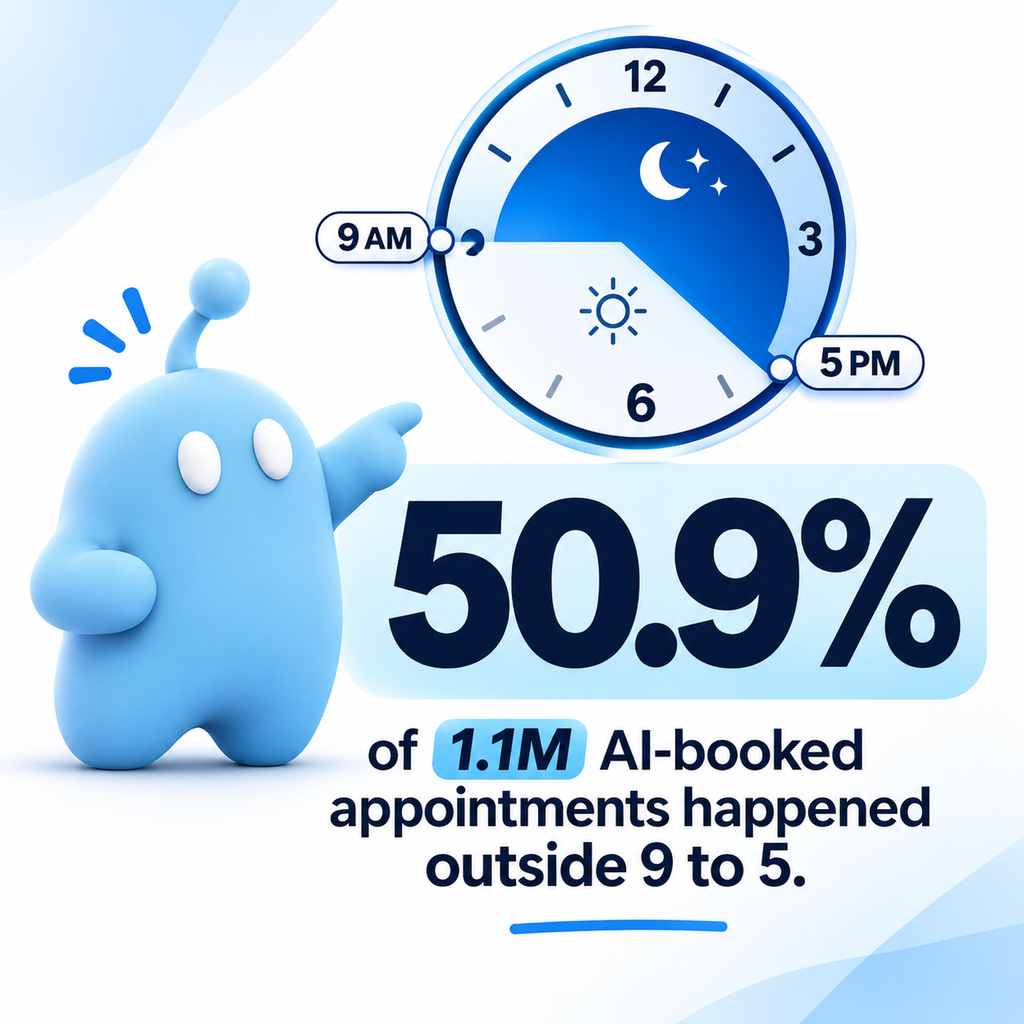
There is a second problem almost nobody measures. CloseBot agents have now booked more than 1.4 million appointments. The analysis in this post covers the first 1.1 million, the point at which we pulled the data. Of those analyzed, 50.9% of them were booked outside 9am to 5pm in the lead’s own local time. Another way to say it: a five-minute response time that only runs during business hours covers, at most, 49% of the moments when leads actually book.
That makes coverage the hardest part of speed to lead.
Key findings from 1.1 million booked appointments
- 50.9% of appointments were booked outside 9am to 5pm, lead local time.
- 22.0% were booked between 9pm and 6am, and 10.7% between midnight and 6am.
- The 7pm hour produced nearly as many bookings as the 10am hour (26,839 vs. 27,432 in the sample).
- Weekends produced 20.4% of bookings and needed 14% fewer messages per booking than weekdays.
- A Friday booking took 29% more messages than a Sunday booking.
- About 1 in 8 bookings (12%) involved more than one channel (changing between email, Facebook Messenger, SMS, etc.) before the appointment was set.
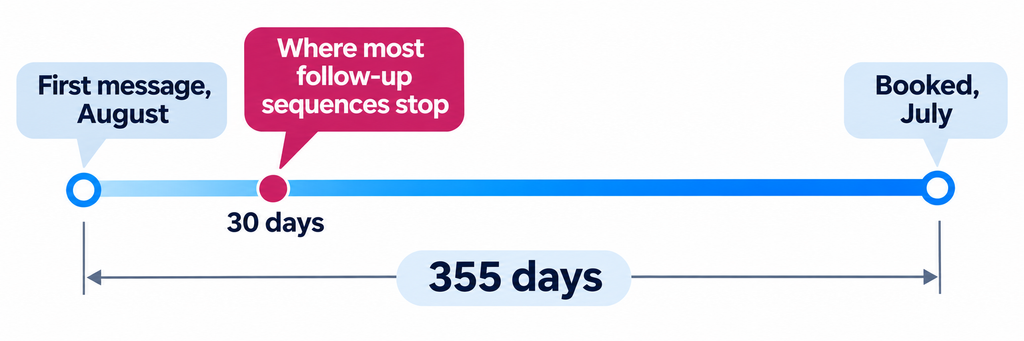
- The longest gap between first message and booking was 355 days.
What is speed to lead?
Speed to lead is the elapsed time from the moment a lead contacts you (a form fill, an ad lead, a text, a DM, a missed call) to the first meaningful reply from your business. It is also called lead response time. Lower is better, and other sources say the industry target is 5 minutes. That’s outdated information.
“Meaningful” matters. An auto-reply that says “Thanks, someone will be in touch” confirms the form worked. It does not answer the lead, and it does not move them toward a booking. A meaningful reply answers their question, asks a qualifying question, or offers a time.
In 2026 leads reward businesses that are able to expedite their journey towards a successful outcome, not just a canned reply saying “we will be with you soon”
How to calculate speed to lead
Speed to lead = time of first meaningful reply minus time the lead came in.
Three habits make the number useful:
- Track the median, not just the average. A handful of leads that sat all weekend will inflate an average. The median shows what a typical lead experiences.
- Track five-minute attainment. Divide leads answered within five minutes by total leads. This is the number to put on a dashboard.
- Break both numbers out by hour of day and day of week. Most teams look fine at 11am on a Tuesday. The misses hide in evenings and weekends, which is where half of bookings happen (see below).
Speed to lead statistics: what the research actually says
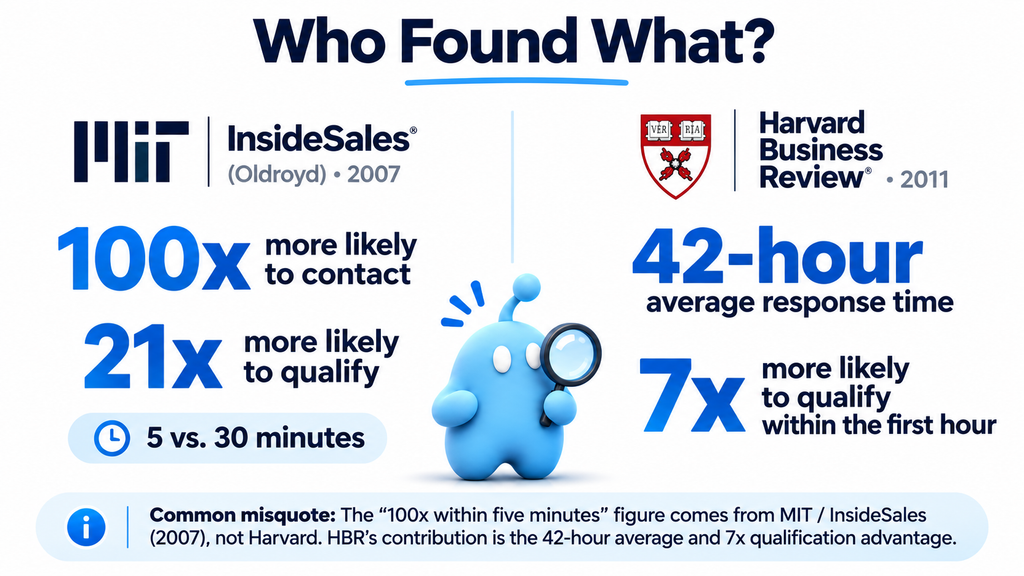
Every credible lead response time study points the same direction: faster replies produce more contacts, more qualified leads and more booked appointments. The numbers get misquoted constantly, so here is who found what.
| Study | Year | Sample | Finding |
|---|---|---|---|
| Lead Response Management Study (MIT / InsideSales, Oldroyd) | 2007 | 6 companies, 15,000+ leads, 100,000+ call attempts | Odds of contacting a lead drop 100x and odds of qualifying drop 21x when you call at 30 minutes instead of 5 |
| The Short Life of Online Sales Leads (Harvard Business Review) | 2011 | 2,241 US companies audited; 1.25M leads analyzed | Average first response of 42 hours; 23% never responded; firms replying within an hour were nearly 7x as likely to qualify the lead |
| Clay speed to lead experiment | 2026 | 6,346 demo and contact forms | About two-thirds of companies never replied; 5% of replies arrived within five minutes |
| Pied Piper real estate lead handling study | 2026 | 2,198 inquiries to 21 brokerage brands | 68% of website inquiries got no response of any kind within 24 hours |
Two corrections worth knowing. The famous “100x more likely within five minutes” figure comes from the 2007 MIT and InsideSales work, not from Harvard. HBR’s own contribution is the 42-hour average and the 7x qualification advantage within the first hour.
The gap in the research
These studies measure how fast companies respond, or how contact odds fall off on early phone dials. None of them measure when leads actually book. That gap matters, because a response time target only helps if someone is there to hit it at the hours leads are ready to commit. That is the question our booking data can answer.
When leads actually book: 1.1 million appointments by hour and day
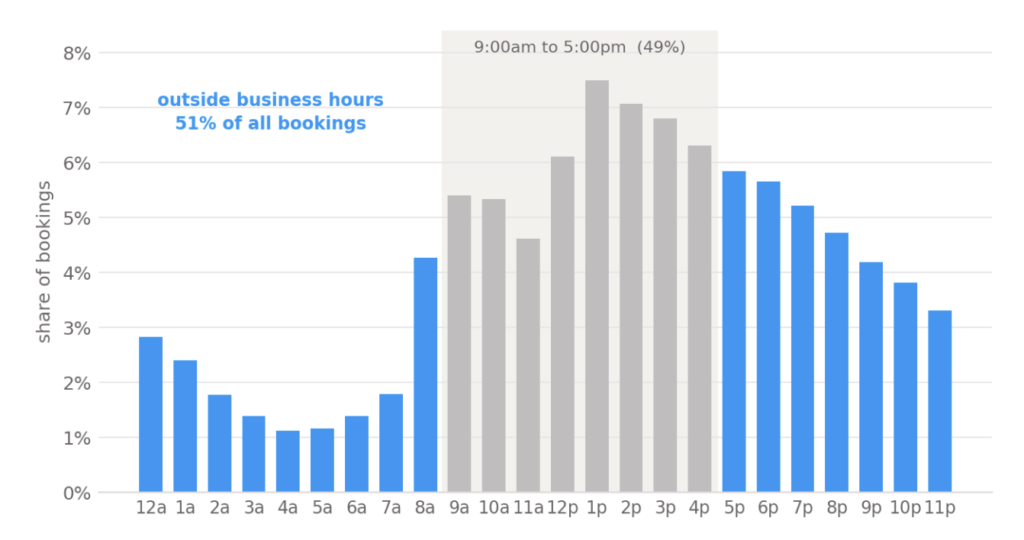
Half of all appointments are booked when a typical sales team is offline. The table below shows every booking in our hourly sample grouped into six windows, measured in the lead’s local time.
| Time of day (lead local time) | Share of bookings |
|---|---|
| Midnight to 6am | 10.7% |
| 6am to 9am | 7.4% |
| 9am to noon | 15.4% |
| Noon to 5pm | 33.8% |
| 5pm to 9pm | 21.4% |
| 9pm to midnight | 11.3% |
What stands out:
- Afternoon is the peak. The single busiest hour is 1pm, with 7.5% of all bookings.
- Evenings hold up far longer than staffing does. One in three bookings (32.7%) happens at 5pm or later. The 7pm hour books nearly as many appointments as 10am.
- Overnight is real volume. More than one in five bookings (22.0%) lands between 9pm and 6am, a window when almost no human team is working.
This lines up with what lead-gen platforms see on the arrival side. LeadSync’s data on 1.69 million Facebook and Instagram lead-ad leads found 75% arrived outside weekday office hours, with 9pm as the busiest hour. Our data shows those off-hours leads do not just arrive late. They book late too, as long as something answers them.
Weekends are the most efficient days to book
Monday through Wednesday carry 50.8% of bookings, so weekday volume is real. But weekend leads convert with less effort than anyone else.
| Day | Share of bookings | Messages per booking |
|---|---|---|
| Monday | 17.5% | 132 |
| Tuesday | 17.2% | 131 |
| Wednesday | 16.1% | 135 |
| Thursday | 14.9% | 141 |
| Friday | 14.0% | 143 |
| Saturday | 10.4% | 124 |
| Sunday | 10.0% | 111 |
Sunday has the lowest volume and the best efficiency of the week. Weekends overall need 14% fewer messages per booking than weekdays, and Friday needs 29% more than Sunday. Messages per booking counts every message sent and received on the platform, including leads who never book, so it reflects total effort per appointment.
Leads messaging a business on their day off want to hear from you. Higher intent.
The likely explanation is intent. Someone messaging a business on their day off chose to be in that conversation. Those leads are the cheapest bookings of the week and the most likely to hit an empty inbox.
What this means for speed to lead
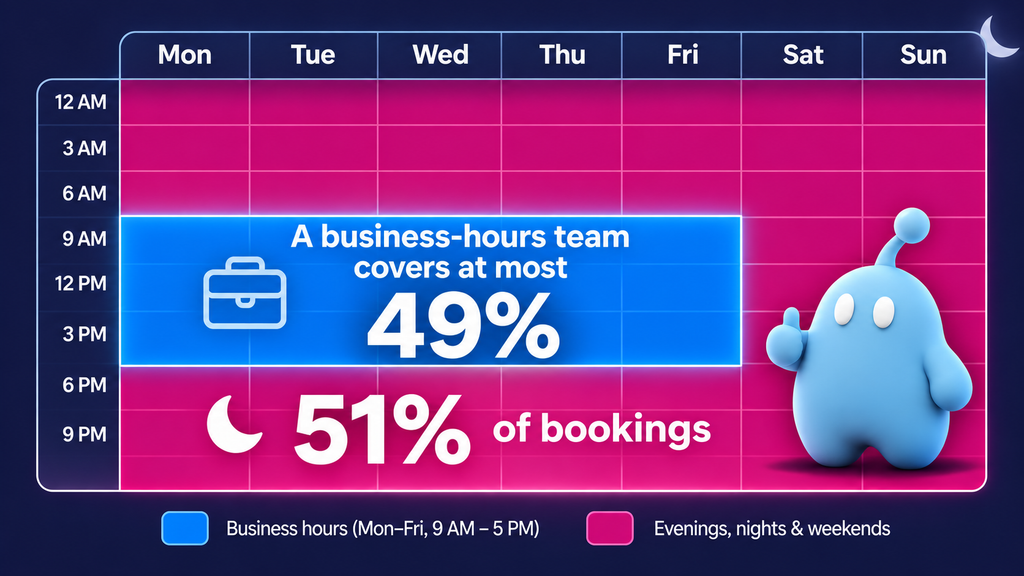
A team that answers every lead within five minutes, Monday to Friday, 9 to 5, is competing for at most 49% of available bookings. The other 51% go to whoever replies first after hours, which is usually whoever has automation running. And the low hanging fruit, motivated, leads that come in on the weekends? They go to a competitor instead. For the full breakdown, see our AI booking benchmarks report.
Speed to lead does not end at the first reply
Most speed to lead advice stops at the first response. Bookings rarely happen on the first response. Across our dataset, the platform averages about 132 messages per booking, counting inbound messages, follow-ups and every lead who never books. A lead who gets an instant first text and then waits three hours for the answer to their second question has the same problem as a lead who waited three hours to begin with.
132 messages per booking counts messages with leads that never book, but the point remains… conversion is a back-and-forth.
Three things keep speed working past the first message.
1. Reply fast on every turn of the conversation
Treat each lead message as a new speed to lead clock. The questions that come after the first reply (price, availability, “do you take my insurance”) are usually the ones that decide whether a booking happens.
2. Follow up for months, not days
The longest gap we recorded between first message and booked appointment was 355 days. That lead was first contacted in early August and booked the following July, from an automated follow-up sequence that never stopped. Most default follow-up windows expire after 30 days. Our automated lead response and follow-up playbook covers cadence in detail, and database reactivation covers the leads that already went quiet.
3. Answer on the channel the lead chose, with one shared history
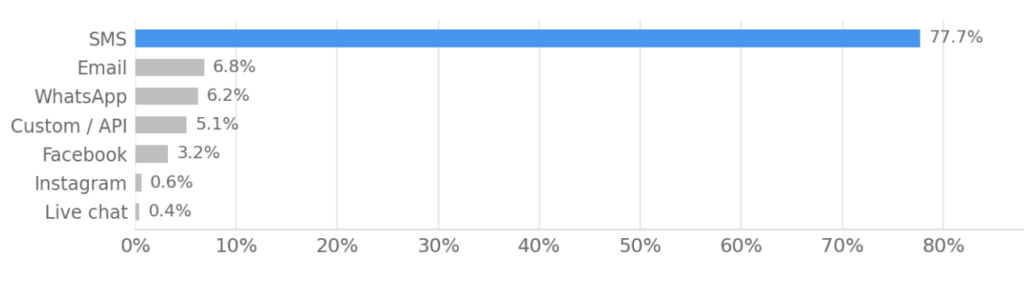
About 12% of bookings (1 in 8) involved a lead who used more than one channel before booking, such as a Facebook DM followed by a text. If each channel starts a fresh conversation, that lead has to repeat themselves, which slows everything down. SMS closed about 78% of bookings in our data, though that share reflects the SMS-first workflows most of our customers run, so read it as volume rather than proof SMS converts best.
Speed to lead by industry
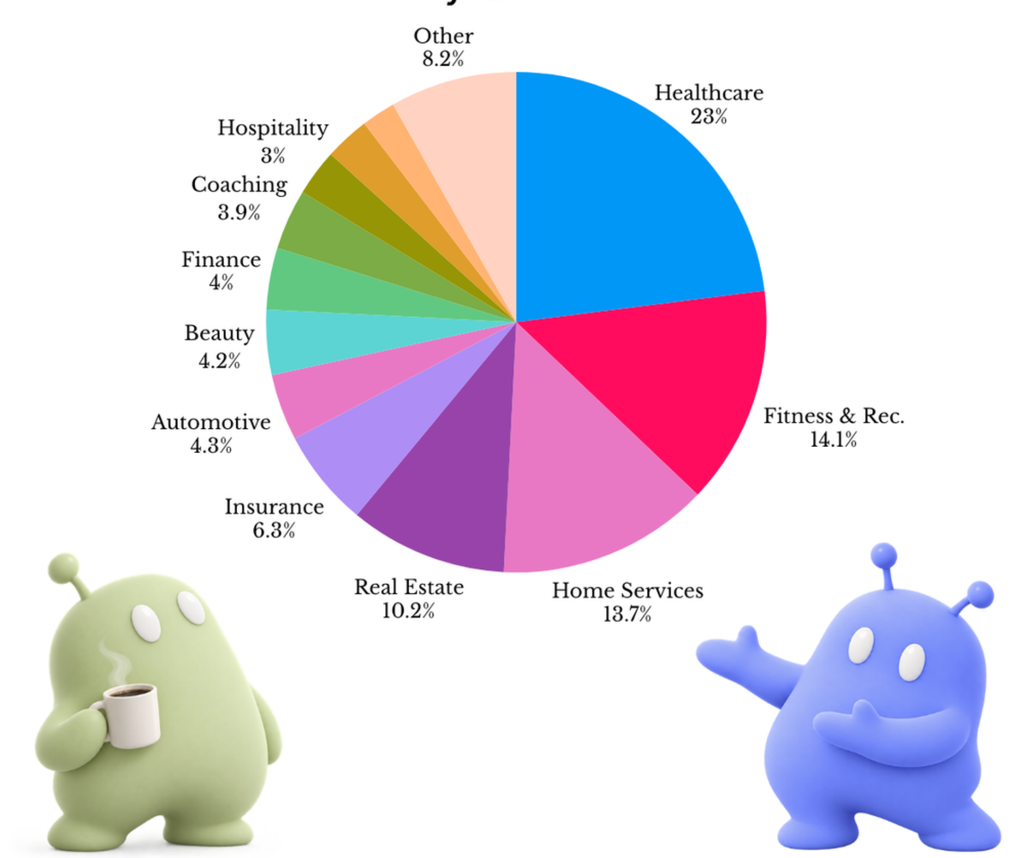
Speed to lead matters most where the sale starts with an appointment. In our study of 12,000+ active businesses using AI sales agents, healthcare (23.0%), fitness (14.1%), home services (13.7%) and real estate (10.2%) make up 61% of the total. Each one sells through a consult, an estimate, a trial class or a showing, and each one loses leads that wait.
Speed to lead in real estate
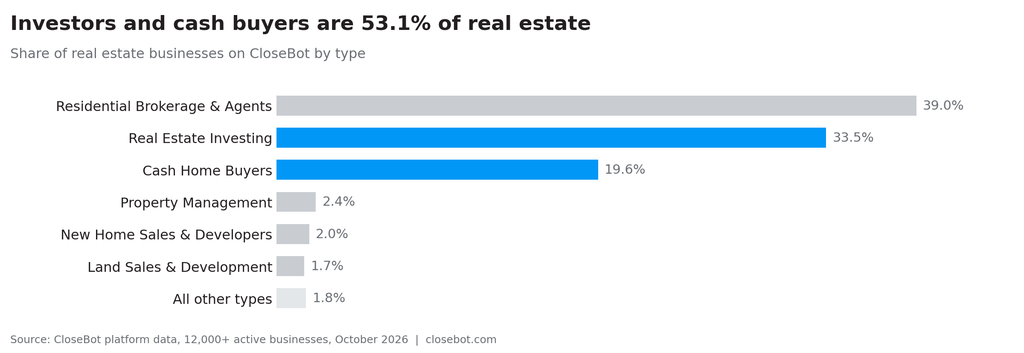
Real estate leads are often bought from portals and ads, and the first agent to reply has a clear head start. Response is weak across the industry: Pied Piper’s 2026 study found 68% of brokerage website inquiries got no response within 24 hours, and only 10% reached an agent within an hour. On the investor side, which makes up 53.1% of the real estate businesses in our data, seller leads can take months to mature. That is where the 355-day follow-up tail comes from. More on AI for real estate.
Speed to lead in healthcare
Dental, med spa and chiropractic make up about 70% of the healthcare businesses in our data. New patient questions show up at night and on weekends, after the front desk has gone home. Instant replies need to stay compliant too, which means HIPAA coverage and signed BAAs across every vendor that touches patient data. More on AI for healthcare practices.
Speed to lead in home services
Home services leads arrive in waves: a storm, a heat wave, the first warm weekend of spring. No human team answers 200 roof leads within five minutes. Pied Piper’s 2026 home services study found no follow-up at all 72% of the time across 3,211 evaluations of large brands. More on AI for home services.
Speed to lead in insurance and lending
Life insurance, Medicare and mortgage leads are often sold to several buyers at once. When five agents receive the same lead, the first credible reply usually gets the call. Shared leads are where speed to lead is closest to a pure race.
How to improve lead response time
The fix is coverage first, speed second. Here is the order we would work in.
- Audit yourself. Submit a test lead through every form, ad and channel you run, at 2pm on a Tuesday and again at 9pm on a Sunday. Log when the first meaningful reply arrives. Most businesses learn more from the Sunday test.
- Measure median response time and five-minute attainment by hour. One company-wide average hides the evening and weekend gap.
- Cover the 51% first. Put an automated responder on nights and weekends before you spend money shaving minutes off business-hours replies. That is where the bookings are going unanswered.
- Make the first reply useful. Answer the question or ask one qualifying question upfront, inviting another reply. Skip the “we’ll be in touch” message.
- Book directly into the calendar. Every handoff (“a rep will call you to schedule”) restarts the clock.
- Keep the same history across channels. One lead in eight switches channels before booking. Losing “memory” between channels drops lead interest fast.
- Set follow-up in months. Leads keep booking long after a 30-day sequence ends.
- Throttle Thursday and Friday first if you must cut volume. They use the most messages per booking. Weekends are the cheapest bookings you have.
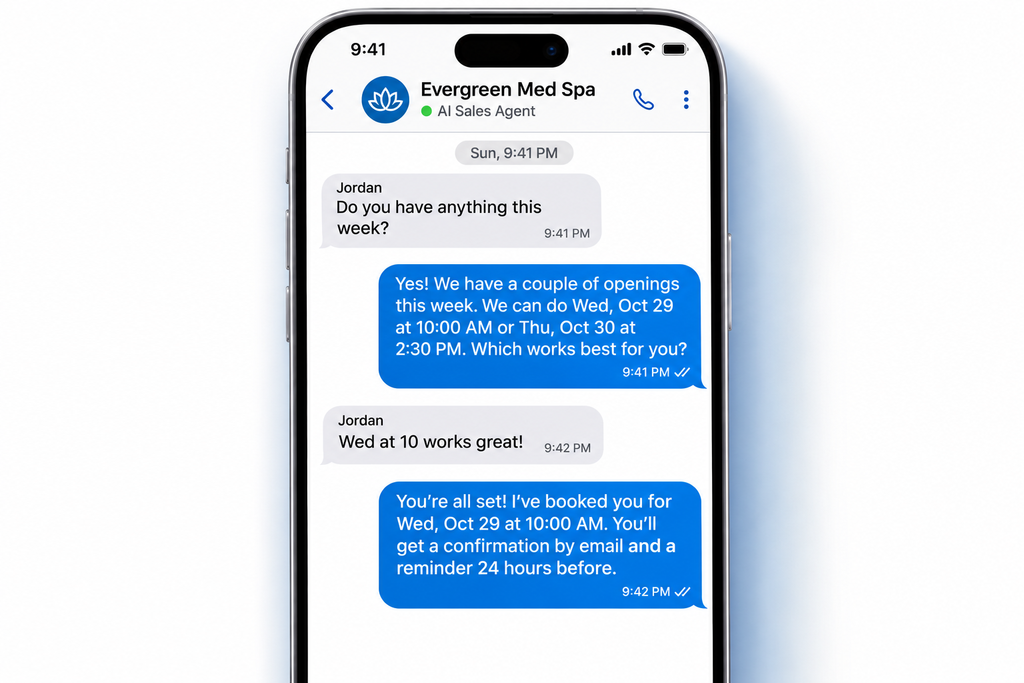
Speed to lead automation: what to automate and what to keep human
Automation solves the coverage problem that staffing cannot. No team can answer within five minutes at 3am, during a storm surge, or when 40 ad leads arrive in an hour. An AI sales agent can reply in seconds at any hour, qualify the lead, answer common questions and book the appointment.
Keep people on the parts that need judgment or a license: pricing exceptions, clinical or financial advice, and the appointment itself. The best setups let the AI handle first contact and follow-up, then hand a qualified, booked lead to the team with the full conversation attached.
Let AI handle lead qualification and booking, let humans handle the appointment itself and ongoing, established, client relationships.
Whatever you use, measure it the same way you would measure a rep: response time by hour, booking rate, and messages per booking. Our analytics overview shows the metrics we track across the platform.
How we measured it
The data comes from more than 1.1 million appointments booked by AI agents on CloseBot across agencies, real estate, home services, healthcare, fitness and other appointment-based businesses. Manually sent messages are excluded.
- Time of day is measured in the lead’s local time zone. Hourly figures come from a sample of 514,467 bookings and are approximate, but the distribution is consistent across pulls.
- Messages per booking counts all platform messages, inbound and outbound, divided by bookings, including leads who never book.
- Channel figures use the channel of the most recent message before booking, which favors whichever channel closes the conversation.
- Privacy: we study aggregate, anonymized trends only. Nobody reads conversations to build these reports, and no individual business, lead or message is published.
CloseBot has now booked more than 1.4 million appointments as of November 2026. Our next series of benchmark reports will release in December 2026.
How to cite this data
Journalists, researchers and agencies are welcome to use these figures. Please credit CloseBot and link to this page.
Suggested citation: CloseBot, “Speed to Lead: What 1.1 Million Booked Appointments Reveal About Lead Response Time,” November 2026, closebot.com.
Sources
- CloseBot platform data, 1.1M+ AI-booked appointments, 2026
- CloseBot: AI booking bot benchmarks from 1.1 million appointments
- CloseBot: Which industries use AI sales agents? (12,000+ businesses)
- Oldroyd, MIT / InsideSales: Lead Response Management Study (2007, PDF)
- Oldroyd, McElheran and Elkington, Harvard Business Review: The Short Life of Online Sales Leads (2011)
- Clay: speed to lead experiment, 6,346 forms (2026)
- Pied Piper: real estate lead handling study (2026)
- Pied Piper: home services lead handling study (2026)
- LeadSync: when Facebook and Instagram leads arrive, 1.69M leads (2026)
Frequently asked questions
Speed to lead is the time between a lead contacting your business and the first meaningful reply they receive. It is also called lead response time. The common target is under five minutes. CloseBot’s data from 1.1 million booked appointments shows the target also has to hold at night and on weekends, since 50.9% of bookings happen outside 9am to 5pm.
Leads cool quickly and often contact several businesses at once. MIT and InsideSales research found the odds of qualifying a lead drop 21x when you call at 30 minutes instead of five. Harvard Business Review found firms replying within an hour were nearly 7x as likely to qualify the lead as firms that waited longer.
Subtract the time a lead came in from the time of your first meaningful reply. Track the median rather than the average, because a few leads left over a weekend distort averages. Also track the share of leads answered within five minutes, and break both figures out by hour and day to find evening and weekend gaps.
The common target is under five minutes, but most teams only hit it during business hours. Few businesses get close: Clay’s 2026 test of 6,346 forms found only 5% of replies arrived within five minutes. Because CloseBot’s data shows 22% of appointments are booked between 9pm and 6am, a good response time has to include nights and weekends.
The five minute rule says you should contact a new lead within five minutes. It comes from the 2007 MIT and InsideSales Lead Response Management study, which found contact odds drop 100x and qualification odds drop 21x when a call happens at 30 minutes instead of five.
No. The 100x contact and 21x qualification figures come from the 2007 MIT and InsideSales study led by James Oldroyd. Harvard Business Review’s 2011 article, which shares authors, reported different findings: a 42-hour average response time, 23% of companies never responding, and a 7x qualification advantage within the first hour.
Harvard Business Review’s audit of 2,241 US companies found an average of 42 hours, and 23% never responded. Newer tests look similar. Clay’s 2026 test of 6,346 forms found about two-thirds of companies never replied, and Pied Piper’s 2026 real estate study found 68% of website inquiries got no response within 24 hours.
In CloseBot’s analysis of more than 1.1 million AI-booked appointments, 50.9% were booked outside 9am to 5pm in the lead’s local time. About 32.7% were booked at 5pm or later, 22.0% between 9pm and 6am, and 10.7% between midnight and 6am.
The afternoon. In CloseBot’s data, noon to 5pm accounts for 33.8% of bookings and 1pm is the single busiest hour at 7.5%. Evenings stay strong: 5pm to 9pm accounts for 21.4%, and the 7pm hour books nearly as many appointments as 10am.
Yes, and efficiently. Weekends produced 20.4% of bookings in CloseBot’s data and needed 14% fewer messages per booking than weekdays. Sunday was the most efficient day of the week, while a Friday booking took 29% more messages than a Sunday booking.
Only if it moves the lead forward. A confirmation like “Thanks, we’ll be in touch” tells the lead the form worked but answers nothing. A response that counts answers the lead’s question, asks a qualifying question, or offers an appointment time. Measure speed to lead from that first useful reply.
Speed to lead automation uses software, usually an AI sales agent, to reply to new leads within seconds at any hour. Good automation does more than send a template: it answers questions, qualifies the lead, books the appointment, and keeps following up until the lead books or opts out.
Start by covering nights and weekends, where about half of bookings happen. Then make the first reply useful, book straight into the calendar, keep one conversation history across channels, and follow up for months. Measure median response time and five-minute attainment by hour so you can see where gaps remain.
For months. The longest gap CloseBot recorded between a first message and a booked appointment was 355 days, from an automated sequence that kept following up. Most default follow-up windows end after about 30 days, long before slow-moving leads such as home sellers are ready to book.
Yes. Portal and ad leads are often shared, so the first agent to reply has a head start, and most brokerages are slow: Pied Piper’s 2026 study found 68% of website inquiries got no reply within 24 hours. Investor and cash-buyer leads also need long follow-up, since sellers can take months to decide.