


Every insurance agent has heard the pitch by now. Plug in AI, and it’ll text your leads, answer questions and book appointments while you sleep.
Some of that is true. AI can respond to a lead in seconds at 2am, follow up for weeks without getting tired, and book straight onto your calendar. But the software is only half the story. An AI agent is only as good as the instructions behind it: what it asks, when it follows up, what it should never say, and when it hands the conversation to a licensed human.
That’s the part most agents don’t have time to figure out. And it’s where teams like Agent CRM earn their keep. CloseBot performs research on what works and what doesn’t, and recommends updates to agents, but a fully-focused agency goes a step further.
The short version
- AI for insurance agents works best when insurance experts build it. The questions, follow-ups and compliance rules are the real product.
- Insurance is a big AI use case. Insurance makes up 6.3% of the 12,000+ businesses running AI sales agents on CloseBot, and about half of those sell life insurance.
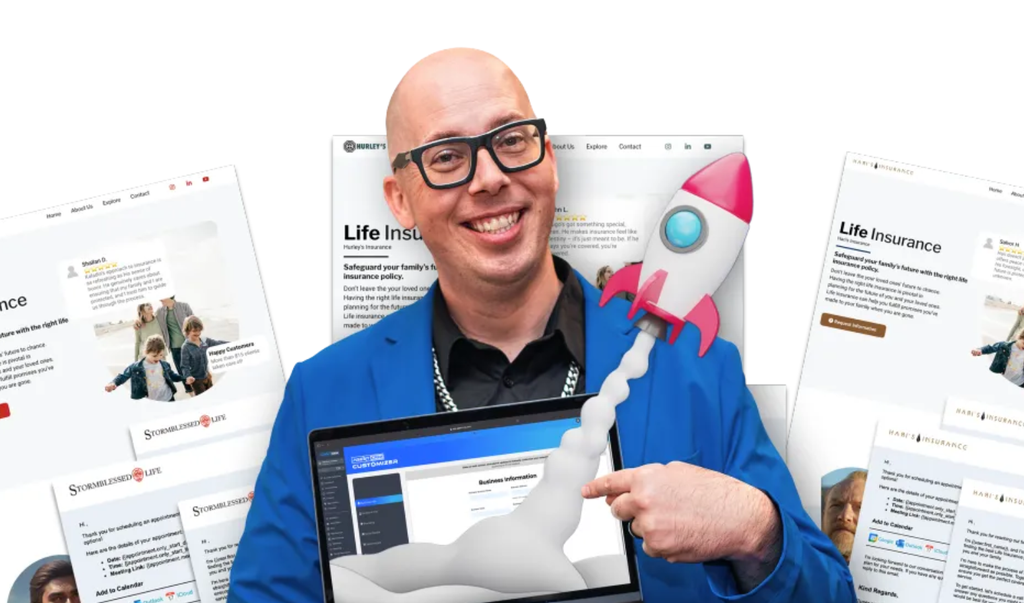
- Agent CRM does the CRM, funnel, website, and AI building for you. Their team packages years of insurance sales experience into a done-for-you system built on HighLevel, with a white-labeled AI agent powered by CloseBot.
- Non-technical agents shouldn’t go at this alone. A long-term partner that keeps testing and tuning is worth more than a blank AI tool.
Why insurance agents are adopting AI sales agents
Insurance has the exact problem AI agents are built to solve. In our industry report covering 12,000+ businesses on CloseBot, insurance makes up 6.3% of businesses. Life insurance is 50.6% of that group, followed by health (19.8%) and Medicare (13.9%).
Those policies close on a call with a licensed agent. So the job of the AI is clear: reply to the lead fast, check that they’re a fit, and get that call on the calendar.
Speed matters more in insurance than almost anywhere else. Many agents buy leads that get sold to other agents too, so whoever replies first usually wins. And leads don’t keep business hours. In our research on 1.1 million booked appointments, about 11% were booked between midnight and 6am in the lead’s local time, and weekends carried 20.4% of all bookings.
No human agent can cover that. Even larger insurance companies with human teams struggle. An AI agent can.
The hidden IP inside a good insurance AI agent
Here’s what people miss when they compare AI tools for insurance. Two agencies can use the exact same software and get completely different results. The difference is everything the agent was taught.
Alex Branning of Agent CRM put it this way:
“There’s a lot of testing and iteration that goes into training any employee to qualify and schedule, including an AI. We understand how the AI should do the job and can get our insurance agents great results that would take them a long time to learn themselves.”
So what does that know-how actually look like? Here are the pieces an experienced insurance team builds in.
1. Knowing what to collect for each line of insurance
Every product needs different information before a licensed agent picks up the phone. A generic AI asks generic questions. An insurance-trained agent knows the short list that matters.
- Final expense: age, state, coverage amount they’re thinking about, who the beneficiary would be, and whether they’d rather meet by phone or in person.
- Medicare: when they turn 65 or their current coverage situation, zip code or county (plan availability is local), and the best time for a call.
- Life and mortgage protection: who needs coverage, rough coverage amount, mortgage details for mortgage protection leads, and tobacco use.
- ACA and health: household size, zip code, whether they’re inside open enrollment or have a qualifying life event.
- P&C: current carrier, renewal date and what they want quoted.
Collecting too little wastes the agent’s call. Asking too much scares the lead off. Knowing where that line sits takes reps.
2. Knowing how to ask
The way a question is phrased changes whether people answer it. Experienced insurance marketers know that “What’s your budget?” gets ghosted, while “Most folks your age land somewhere between $30 and $80 a month. Does that sound about right?” gets a reply.
They also know when to ask. Sensitive questions go after rapport is built, never in the first text. And the AI should never quote premiums or give advice. That’s the licensed agent’s job, and a good build makes sure the AI hands off cleanly when a lead asks something only a licensed agent should answer.
3. Knowing the follow-ups that actually work
Most insurance leads don’t book on the first message. The follow-up cadence is where a huge share of the revenue lives, and it’s also where DIY setups fall apart.
A tuned insurance agent knows:
- How many times to follow up and over what stretch of days
- Which messages re-open a cold conversation without feeling pushy
- How to respond to “just send me something in the mail” or “I’m just looking”
- When to stop, so a number doesn’t get burned
We’ve written more about this in our playbook for automated lead response and follow-up. The short version is that most people give up far too early.
4. Knowing the compliance landscape
Insurance is regulated, and AI doesn’t get a pass. Texting leads means following TCPA consent rules, respecting quiet hours and running on properly registered A2P numbers. Medicare agents also have to follow CMS marketing rules, including how and when they collect a Scope of Appointment.
Health details come up constantly in insurance conversations, too. That’s one reason Agent CRM includes HIPAA-ready infrastructure in its plans, and why CloseBot’s Growth Plan includes HIPAA with signed BAAs across our entire provider stack, including our LLM and infrastructure providers.
An agent who’s trying to learn all of this while also selling policies is going to miss something. A team that lives in it every day won’t.
Why a white-label AI agent lets the experts shine
This is where platforms like HighLevel and CloseBot change the game for insurance-focused agencies.
CloseBot is white-label friendly. An agency can put its own name on the AI agent, load in its own playbook, and deliver it to every client from one account. The agency brings the insurance expertise. CloseBot handles the conversation engine underneath: reading messages, managing follow-up timing, checking calendars and booking.
Agent CRM is a great example of what that looks like done right. They built an insurance CRM on HighLevel and loaded it with insurance-specific workflows, pre-built campaigns for every major line of insurance, training and support from people who understand the business. Their AI agent runs on CloseBot under their own brand, trained with the same insurance knowledge that powers the rest of their system.
The result is something an individual agent could never build alone: a fully set up sales system where the AI already knows how insurance gets sold.
HighLevel has recognized Agent CRM at its Diamond tier, which is reserved for partners serving 1,000+ businesses. That kind of scale doesn’t happen by accident. It comes from years of listening to agents, testing what works and building it into the product.
Done for you, for the long haul
Agent CRM’s customers are insurance professionals, not software people. Most of them don’t want to learn workflow builders, write AI prompts or debug a follow-up sequence at 10pm. They want to sell policies and take care of their clients.
That’s why the long-term done-for-you model matters so much. An AI agent isn’t a one-time setup. Carrier products change, lead sources change, compliance rules change, and the AI models themselves get better every few months. A partner like Agent CRM keeps tuning the system as all of that moves, so the agent keeps getting results years from now.
We have a lot of respect for the work their team does. They take a powerful but complicated stack and turn it into something an agent can actually use on day one, then they stick around to keep it working.
Why Agent CRM chose CloseBot
When a team like Agent CRM puts their name on an AI agent, their reputation goes with it. So they need the engine underneath to be deep, reliable and focused on results.
- Depth. CloseBot is built only for AI sales conversations. That focus lets insurance experts build detailed qualification, follow-up and handoff logic into a single agent, without stitching together dozens of workflow steps.
- Quality. CloseBot handles roughly 150,000 messages a day across thousands of businesses. We study anonymized, aggregate trends from that volume (never the contents of individual conversations) to improve defaults for everyone, like which follow-up cadences convert and which AI models handle sales conversations best.
- Reliability. When an agent’s leads depend on instant replies at 2am, downtime costs real money. Reliability is a core reason agencies run on a dedicated conversation platform.
- More revenue. Better conversations mean more booked calls, and more booked calls mean more policies written.
You can see how CloseBot stacks up against HighLevel’s built-in tools on our HighLevel vs CloseBot comparison page.
What insurance agents should look for in an AI agent
If you’re shopping for AI for your insurance business, here’s a simple checklist:
- Who built the playbook? Ask whether the questions and follow-ups were written by people who sell insurance.
- Does it hand off to a licensed agent? The AI should book the call and stay out of advice and pricing.
- How long does it follow up? A few messages over two days isn’t enough for most insurance leads.
- Is it compliant? Ask about TCPA, A2P registration, Medicare marketing rules and HIPAA.
- Who keeps it working? Look for a partner who keeps testing and improving, not a one-time install.
If you’d rather skip the learning curve, a done-for-you partner like Agent CRM gives you an insurance-ready system with an AI agent that already knows the job.
Frequently asked questions
Most insurance agents use AI to reply to new leads instantly, ask a few qualifying questions, follow up with leads who go quiet, and book calls with a licensed agent. The AI handles the back-and-forth so the agent can spend time on calls that are likely to close.
The best AI for insurance agents is one that’s been trained by people who know insurance. Look for insurance-specific qualifying questions, long follow-up sequences, a clean handoff to a licensed agent and built-in compliance. Done-for-you platforms like Agent CRM package all of this together.
No. In most lines, policies close on a call with a licensed agent. AI handles the first contact, qualification and booking, which frees licensed agents to do the selling and advising only they can do.
It can be. The AI needs to follow TCPA consent rules and quiet hours, send from registered A2P numbers, and follow CMS rules for Medicare marketing. Health information should only go through HIPAA-ready systems with signed BAAs.
A white-label AI agent is an AI platform that an agency can brand as its own. The agency adds its expertise and playbook, and the platform runs the conversations underneath. Agent CRM’s AI agent is white labeled on CloseBot.
On CloseBot, life insurance makes up 50.6% of insurance businesses, followed by health (19.8%) and Medicare (13.9%). Together, personal coverage accounts for 84.3% of insurance businesses on the platform.
Read more: Insurance agent AI that qualifies, supports and books · Which industries use AI sales agents? · Done For You builds