


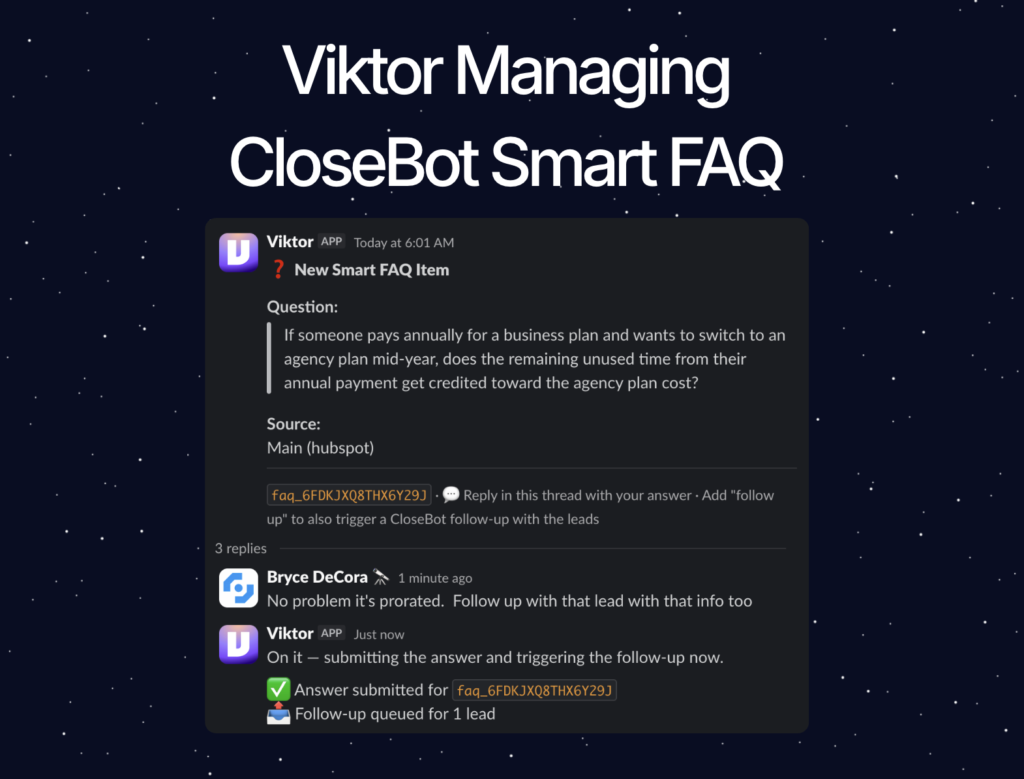
We use Viktor every day. It found files in our Google Drive. It watched Reddit for CloseBot mentions. It generated alt text and thumbnails for our videos and website content. It even managed our own CloseBot account (AI for sales automation), notifying us when new Smart FAQ items needed attention and automated follow-up to answer lead inquiries.
Viktor was good. Really good. A bit expensive, but that doesn’t matter when it drives massive value in the form of saved time.
However, we’re replacing it with Claude Tag. This post explains why. It’s not because Viktor failed us. It’s because we have seen the same thing that’s playing out now played out several times in the past.
If you run a business that depends on AI tools, whether that’s an automated lead follow up system, an internal team assistant, or conversational AI for sales, you need to read this. The tool you pick today might not exist in six months.
Tools like Grammarly, General Q&A Chatbots, Drag and Drop site builders with AI implementation taking shape… wiped within months of similar capabilities being announced by the likes of Anthropic and OpenAI.
What Are Viktor and Claude Tag?
Let’s clear up some things for anyone reading who doesn’t know what these tools are or where they stand today.
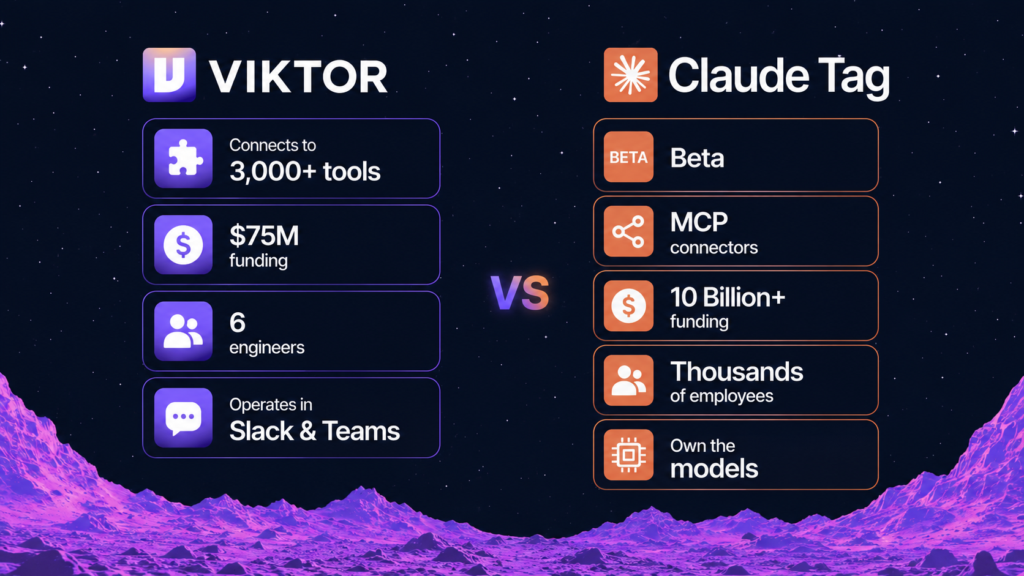
Viktor is an AI assistant that lives in Slack and Microsoft Teams. It connects to 3,000+ tools, runs tasks on its own, and acts like a digital coworker. It launched in February 2026 and raised a $75 million Series A from Accel in May. Six engineers. Offices in Warsaw and Munich.
Claude Tag is Anthropic’s brand new AI teammate available only in beta, also built into Slack. It launched June 23, 2026. It’s multiplayer… one shared Claude per channel that anyone can talk to. It reads your conversations, connects to your tools via MCP connectors, and works tasks asynchronously. It’s in beta for Claude Enterprise and Team plans.
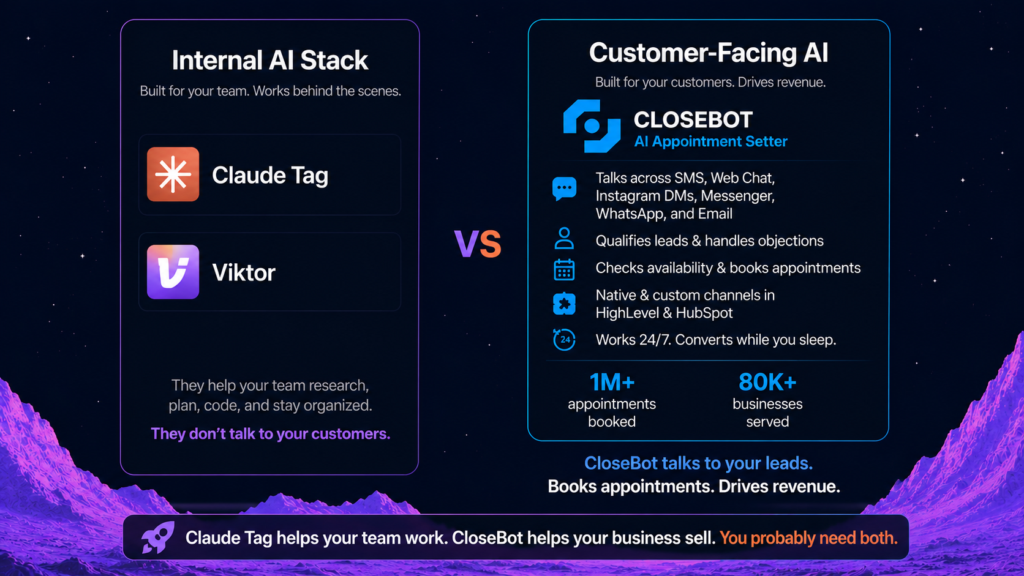
Both are internal team assistants. They sit inside your workspace. They help your people get work done faster. They are not customer-facing. This is an important distinction between these two and other tools like CloseBot, which are designed specifically for better price at scale, agency setup for re-selling and monitoring and gating access to things your clients shouldn’t be allowed to do… like ask for your collection of cat videos within your connected Google Drive account 😉
More on that later.
Why We’re Making the Switch
Viktor is the better product right now. We’ll accept that.
It has more integrations out of the box. It runs on Teams and Slack. It’s more proactive. It chases deadlines without being asked. For raw capability today, Viktor wins.
In pre-AI days the discussion would end there, but things change faster than ever now. I don’t know about you, but I’m getting tired of being jerked around. So why leave?
- Anthropic ownership of the models
- Anthropic has much deeper pockets
Viktor is built on top of foundation models made by companies like Anthropic and OpenAI. Claude Tag is built by the company that makes Claude. No one understands Claude’s capabilities, limitations and future like the Anthropic team. An advantage that shouldn’t be ignored.
Anthropic has raised over $10 billion. They have thousands of employees. They own the intellectual property, the actual neural networks, that power tools like Viktor under the hood.
Viktor raised $75 million. They have six engineers.
That’s not a knock on Viktor’s team. They’re clearly talented. They hit $15 million ARR in ten weeks. But when the company that owns the foundational AI models enters your space, history tells us what happens next. They either acquire you or they outrun you.
Unless you’ve carved out a niche they don’t care about, you’re in trouble.
Claude Tag is a week old and it’s already good enough. Not as polished as Viktor in every area. But good enough. And Anthropic will improve it. Fast. They have the resources, the model access, and the infrastructure roadmap to make Claude Tag the default within a year.
We’d rather switch now while we are early in the integration process, than switch later when we’ve built months of workflows on a platform we’re not sure will be around long term.
The Honest Comparison
We’ve personally tested Viktor and Claude Tag, but we have many users of CloseBot who have tested other open sourced alternatives as well that shouldn’t be ignored.
Claude Tag vs. Viktor
The two true Slack-native coworkers. This is the fight that matters most.
Where Claude Tag Wins Now 🏆
- Backed by a larger team, more funding, more resources overall
- Seperate identity per slack channel so different teams have access to different capabilities.
- Clear audit trail of token use and actions taken by the assistant
Where Claude Tag Loses Now ❌
- Claude Tag isn’t as proactive. It doesn’t come pre-built with timers designed force an understanding of its capabilities.
- Claude Tag is behind in integrations, where Viktor has had more time to build their 3,000+ integrations
What About Open-Sourced Options like OpenClaw and Hermes?
Managed-and-safe vs. free-and-yours. Two totally different philosophies. The comparison between Claude Tag and open-sourced options that you own is more ambiguous.
For us at CloseBot, these are the advantages Claude Tag has over open-sourced options. Your appetite for each may be different than ours.
Where Claude Tag Wins Now 🏆
- Enterprise-ready with permissions, logging, limits, etc.
- Someone else keeps it running and evolving, not me
Why do these two points matter enough for us to agree to spend more and lose control?
It may come as a surprise… but we are focused on CloseBot at CloseBot 😅 We don’t tinker with other tools for the sake of tinkering. We have plenty to do in building the absolute best in conversational AI for sales.
TLDR;
If you want the safe, easy option that’s highly capable right now, choose Viktor. If you have fun tinkering and building custom stuff, use Hermes or OpenClaw. If you’re focused on your own product or service and want a general assistant that has the highest potential of being around in 6+ months, use Claude Tag.
Where CloseBot Fits (And Doesn’t)
Here’s the thing none of these tools do: talk to your customers.
Claude Tag, Viktor, Hermes, OpenClaw… they’re all internal. They help your team. They don’t sit in your SMS inbox at midnight qualifying a lead who just filled out a form on your landing page.
That’s what CloseBot does.
CloseBot is customer-facing conversational AI for sales. It’s an AI appointment setter that talks to your leads across SMS, web chat, Instagram DMs, Facebook Messenger, WhatsApp, and email. It qualifies leads, handles objections, checks calendar availability, and books high-intent appointments. It plugs directly into HighLevel and HubSpot conversation channels that are native and custom… the places where your actual customers are reaching out.
It’s not a general assistant for your internal team. It’s a specialist that does one thing at scale: convert inbound leads into booked appointments, 24/7, without adding headcount.
We’ve booked over a million appointments for 80,000+ businesses. That’s the kind of focus a general-purpose AI coworker can’t replicate and won’t replicate. They have their focus; we have ours.
So when we talk about switching from Viktor to Claude Tag, we’re talking about our internal stack. The tool our team uses to stay organized. CloseBot is a different category, and it’s the one that actually touches your revenue.
Think of it this way: Claude Tag is the AI that helps your team work. CloseBot is the AI that helps your business sell. You probably need both.
Think About the Future Before You Build
You don’t have to make the same switch we did. But think about it before you invest the time.
Stay connected with us. We’ll keep sharing what we learn as the AI landscape shifts. The tools will keep changing. The businesses that pay attention will win.
FAQ
What is the difference between Viktor and Claude Tag?
Viktor is an AI assistant built by Zeta Labs that connects to 3,200+ tools and runs inside Slack and Microsoft Teams. Claude Tag is Anthropic’s AI teammate that lives in Slack with multiplayer collaboration, per-channel identity isolation, and full audit logging. Viktor offers more integrations and autonomy today. Claude Tag offers stronger enterprise controls and is backed by the company that builds the foundational AI models Viktor runs on.
Viktor is more capable right now — more integrations, Teams support, and proactive task management. Claude Tag is newer but offers better security controls, admin spend caps, and audit trails. The long-term advantage goes to Claude Tag because Anthropic owns the underlying AI models, has raised over $10 billion in funding, and has the resources to improve Claude Tag rapidly.
Claude Tag is Anthropic’s Slack-native AI teammate launched in June 2026. It’s a shared, multiplayer AI — one Claude per channel that everyone on the team can interact with. It reads conversations, connects to tools via MCP connectors, executes tasks asynchronously, and builds persistent memory over time. It’s available in beta for Claude Enterprise and Team plan customers.
Viktor is an AI agent built by Zeta Labs that operates as a digital coworker inside Slack and Microsoft Teams. It connects to over 3,200 tools, automates workflows, generates reports, manages projects, and executes tasks autonomously. It launched in February 2026, is backed by a $75 million Series A from Accel, and is built by a team of six engineers based in Warsaw and Munich.
No. Viktor and Claude Tag are internal team assistants — they help your employees work faster, not talk to your customers. For customer-facing AI that qualifies leads, handles objections, and books appointments at scale across SMS, web chat, and social channels, you need a specialized tool like CloseBot. CloseBot plugs into HighLevel and HubSpot conversation channels and has booked over a million appointments for 30,000+ businesses.
It depends on what you mean by “sales automation.” For internal team productivity — reports, project management, workflow automation — Claude Tag or Viktor are strong options. For an automated lead follow up system that actually talks to leads, qualifies them, and books appointments 24/7 across SMS, Instagram DMs, Facebook Messenger, WhatsApp, and email, CloseBot is purpose-built for that. The best AI for sales automation is a specialist, not a generalist.
OpenClaw is powerful and free, but it carries significant security risks. Security researchers found malicious code in its skill marketplace, and Microsoft advised against running it on work computers. For hobbyists or isolated testing, it can be useful. For a real business handling customer data and sensitive information, it’s a liability. Claude Tag is a safer alternative with locked-down permissions and full audit logging.
An AI team assistant like Claude Tag or Viktor helps your internal team — finding files, automating workflows, generating reports, managing projects. An AI sales assistant like CloseBot is customer-facing — it converses with leads in real time across SMS, web chat, and social channels to qualify them, handle objections, and book appointments. One helps your team work. The other helps your business sell. Most companies need both.
Hermes is best for technical teams that want full control. It’s free, self-hosted, model-agnostic, and keeps all data on your own machine. But you handle all setup, maintenance, and troubleshooting yourself. Claude Tag costs more but requires zero setup, runs on Anthropic’s infrastructure, and works for non-technical team members. If you don’t have a developer on staff to maintain Hermes, Claude Tag is the better choice.
Viktor has strong early traction — $15 million ARR in ten weeks and $75 million in funding from Accel. But it’s a five-month-old product built by six engineers competing against Anthropic, a company with over $10 billion in funding that owns the AI models Viktor depends on. When the company that makes the foundational technology enters your market, smaller players either get acquired or outpaced. That risk is why we’re switching to Claude Tag now rather than later.