

AI Tool – something that every app has in their website tagline. AI tools for marketing agencies are easy to find. That’s not the problem. Project management AI tool, email client AI tool, coffee machine AI… ☕️
Throw a rock in any direction and you’ll hit an AI tool. But which AI tool is worth the investment? Which ones actually drive results? Which ones are built with AI at the heart instead of a sprinkle of AI on top in an effort to check a box?
Most importantly… which of the many AI tools for marketing agencies drive more revenue for you and your clients?
CloseBot has thousands of marketing agency users. We see a lot of what works and what doesn’t. This guide includes 6 of the best tools we see our top agencies using… and we use each of these tools ourselves as well. You’ll see the best tools for:
- Sales Conversations
- Customer Management
- Fulfillment
- Knowledge Management
- Internal Operations
- Support
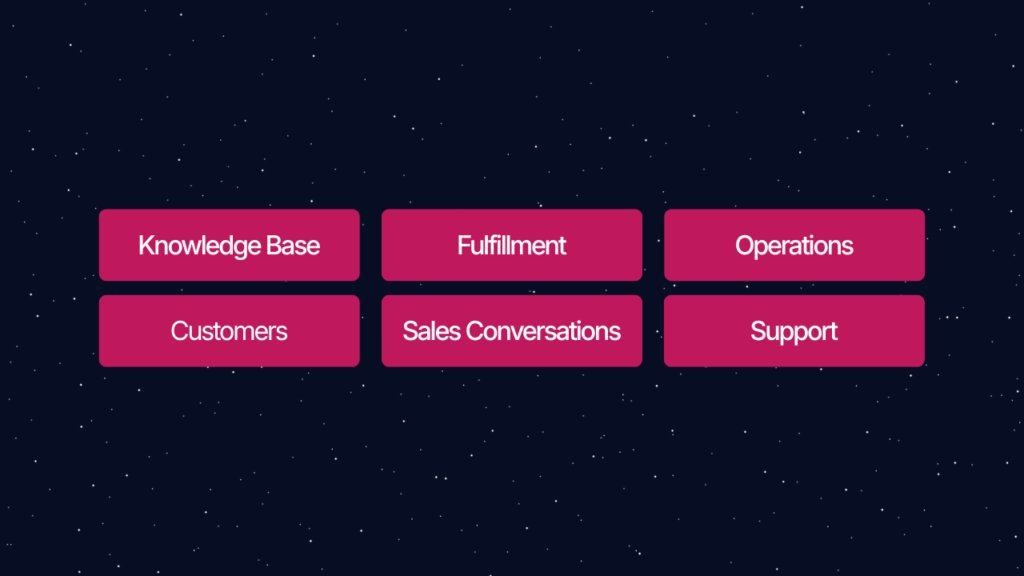
Each of the tools mentioned for each of the 6 categories is arguably the best at that specific job. Despite what some want us to believe, you cannot have an all-in-one tool that’s the best at everything. If you want to offer the best for your clients, it will take a coordination of different tools to fulfill on that promise.
1. CloseBot – Sales Conversations
It’s instinct for agencies to focus on building, supporting, and playing with shiny new tools… sales is oftentimes forgotten. Sales is the most important part of the success (or downfall) of your agency, which is why we want to start here.
CloseBot acts as the leading sales AI tool for marketing agencies: talking to leads the moment they come in, qualifying them, and booking them onto a calendar without a human setter. Anymore, this isn’t a novel topic. HighLevel even has their own Conversational AI built-in to the product. We will explain why you’re better off investing in CloseBot instead of using the built-in features of all-in-one tools below.
Despite the rise of these sales AI systems, speed to lead is still the metric that makes or breaks most agency campaigns. You can generate perfect leads for a client, but if nobody responds for four hours, the campaign “doesn’t work” and you’re on a churn call by month two. That’s the problem conversational AI exists to solve, and it’s why using the best conversational AI provider is extremely important.
CloseBot handles two-way conversations over SMS and other messaging channels, qualifies leads based on criteria you define, answers objections, and books appointments directly onto calendars. For agencies, it’s designed to be resold: you can run it across many client subaccounts and offer AI appointment setting as part of your service. This works natively with HighLevel, HubSpot or standalone, having booked over 1 million appointments with qualified leads to date.
One Agent.
Every Channel.
Zero Stitching.
You deserve better than hacked together systems that claim intelligence, but fall short on what you would expect.
CloseBot takes over all text-based channels within your CRM, replying and following up when you want and how you want to close deals.
 Agents
A few things worth knowing if you're evaluating tools in this category
Setup complexity matters more than feature count. Many conversational AI builders like ManyChat require you to map out elaborate flowcharts one node for greeting, one for qualifying, one for objections, one for booking, with branching logic between them. CloseBot allows you to build that way if you want, but CloseBot's agent node approach collapses that into a single node that can handle the full conversation: qualification, objection handling, and booking in one place. When you're deploying bots across dozens of client accounts, the difference between a 10 minute setup and a two-day setup compounds quickly.
Reliability is a client-retention issue, not a technical detail. If your AI goes down for an afternoon, your clients' leads sit unanswered and you're the one explaining why. CloseBot maintains 99.99% uptime, which is the kind of statistic that sounds boring until the day it isn't.
Pricing scales. Some tools in this category look affordable at one or two subaccounts and get expensive fast as you add clients. CloseBot's pricing is structured to get cheaper per account as you scale, which fits the agency model better... your margin should improve as you grow, not shrink.
One honest caveat: CloseBot is optimized for sales conversations. If you're looking for AI to deflect support tickets or answer product documentation questions, that's a different job; more on that in the Intercom section below.
2. HighLevel - Contact Management
The operating system your agency and your clients live in... CRM, pipelines, funnels, calendars, and white-label everything.
If you run an agency serving local businesses, there's a good chance you're already on HighLevel. It's become the default platform for the agency model: you get a full CRM, funnel builder, email and SMS marketing, calendars, reputation management, and the ability to white-label the entire thing as your own SaaS.
HighLevel's strength is breadth. It replaces what used to be five or six separate subscriptions with hacky integrations between them, and its subaccount structure maps perfectly to how agencies manage clients. If you're not on a platform like this yet, it's usually the first piece of the stack to put in place. Most of the other tools on this list plug into it.
Conversational AI for HighLevel
HighLevel also ships its own conversational AI features, and they've improved steadily. But it's worth being clear-eyed about what HighLevel is: a CRM and marketing platform first. Conversational AI is one feature among thousands, not the company's core focus.
That's not a knock against them... when you're an all-in-one tool you cannot be the best in every category.
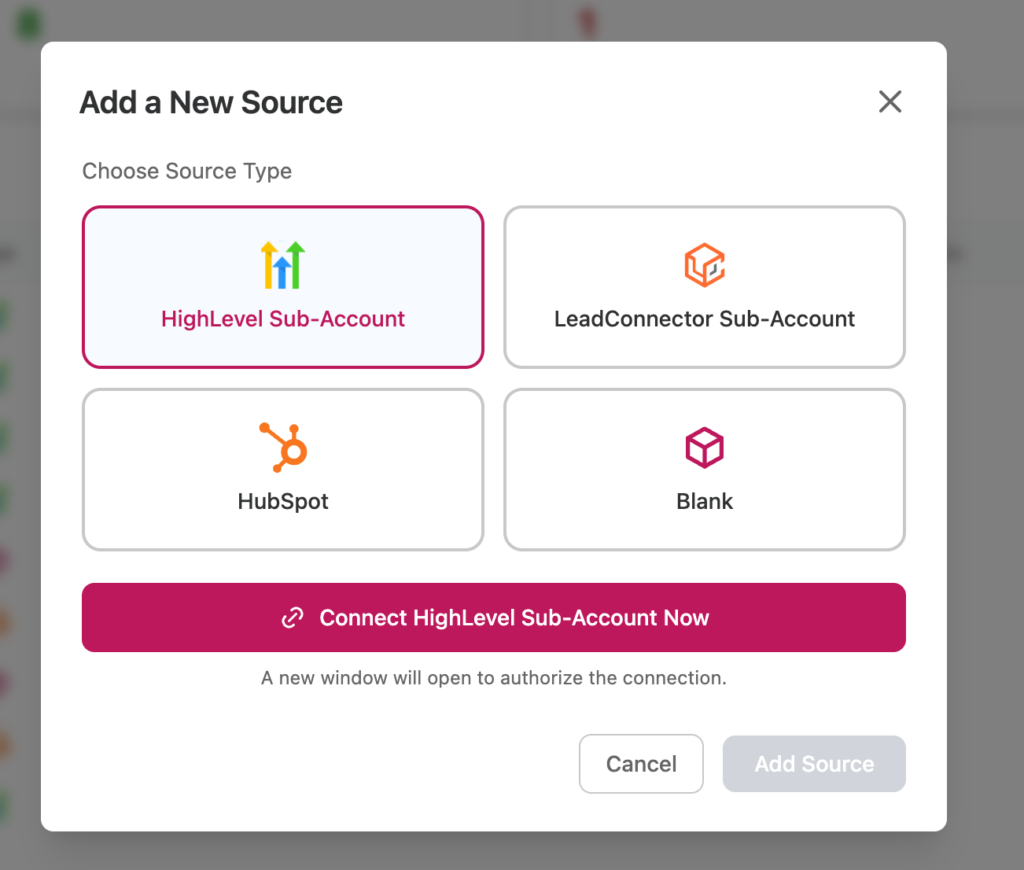
This is why HighLevel has a marketplace, and why the most common pattern among established agencies is HighLevel as the backbone plus specialized tools plugged into it. For conversational AI specifically, CloseBot is the top-rated conversational AI in the HighLevel marketplace, and the pairing is popular for a few practical reasons: the new single agent node setup is faster to deploy per client than building out conversation flows natively, the dedicated infrastructure comes with stronger uptime guarantees, and the cost ends up being cheaper with CloseBot as you scale.
The takeaway isn't "don't use HighLevel's AI"... it's that the CRM and the conversational AI are different jobs, and agencies running at volume tend to want a specialist handling the conversations that turn into booked revenue.
3. Claude Code - Fulfillment
The technical team member you don't have... now works in your command line. Automation, integration, reporting, and fulfillment work across your entire stack without learning a new front-end.
This is the entry on the list most agency owners haven't tried yet, and it's probably the one with the highest ceiling. It can seem scary at first since it operates within your computer's command line, but every one of our agency users we've convinced to try it love it.
Why is this on our list of AI tools for marketing agencies? Isn't is a developer tool?
Claude Code was built for software developers, but here's the thing... most of what agencies pay developers and technical VAs to do isn't traditional software development, but glue work. Connecting one tool to another. Pulling data from an API and formatting it into a report. Importing contacts. Building a landing page. Writing a script that cleans up a lead list. Claude Code does all of this from plain-English instructions.
How this Helps Agencies Scale
You describe what you want, and it writes and runs the code to make it happen.
Where it gets genuinely powerful for agencies is API orchestration. Any tool with documented APIs becomes something Claude Code can operate on your behalf. Point it at CloseBot's API documentation, for example, and it can take action inside your account, creating and updating bots, managing configurations across client subaccounts, or pulling conversation data for reporting. The same applies to the rest of the tools in this list, which all have APIs.
That turns Claude Code into a kind of general assistant that sits above your whole stack. Some real-world examples of what that looks like:
- "Pull this week's booked appointments from CloseBot and update the client scorecards in Notion."
- "Create ClickUp tasks for every new client in HighLevel, using our standard onboarding template."
- "Build a monthly report that combines lead data from HighLevel with conversation outcomes from CloseBot."
- "Clone this landing page, swap in the new client's branding, and deploy it."
None of these require you to know how to code. They require you to describe the outcome clearly. If you've ever written an SOP for a VA, this is a skill you already have.
For fulfillment-heavy agencies, this is the closest thing to hiring a technical operations person without the salary. It won't replace your senior developer if you have one, but it will replace a surprising amount of the routine technical work that clogs up your delivery pipeline.
4. Notion - Knowledge Base
A single source of truth for your team, for your clients, and increasingly, for your AI.
Every agency accumulates knowledge: SOPs, client onboarding docs, campaign playbooks, brand guidelines, meeting notes, offer details. The agencies that scale smoothly are the ones where that knowledge lives somewhere structured instead of in the founder's head and a graveyard of Google Docs.
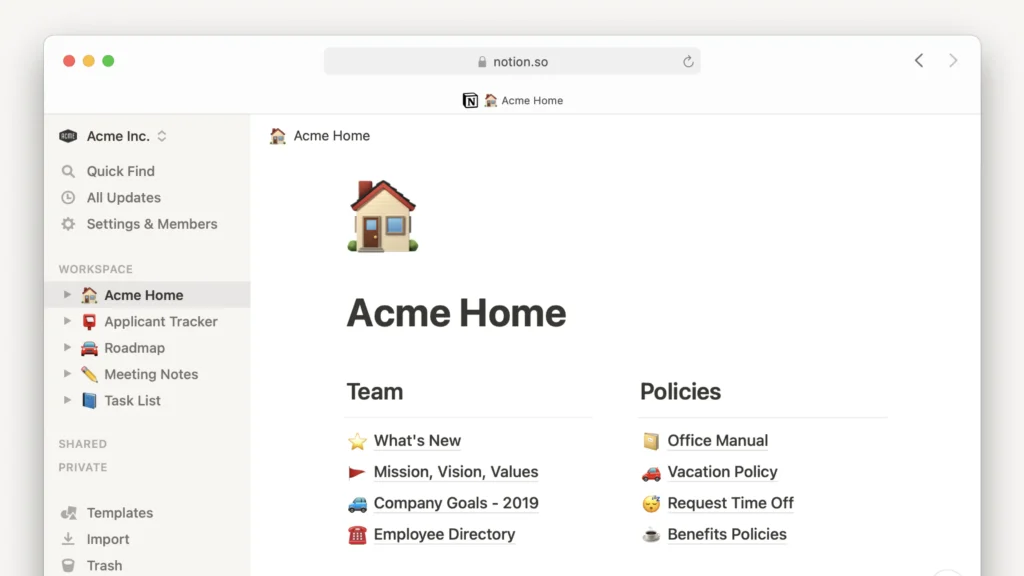
Notion remains the best tool for this job. It's flexible enough to be a wiki, a client portal, a project doc, and a database all at once, and its AI features have matured into genuinely useful search and summarization across your workspace. For agencies, the two highest-value patterns are:
Client-facing knowledge bases. A shared Notion space per client... onboarding checklists, deliverables, reporting, brand assets. Having this put together makes you look organized and cuts down the "can you resend that?" emails dramatically.
Internal SOPs and playbooks. Your fulfillment processes, sales scripts, and campaign templates, documented once and reused across every client.
Notion for AI Knowledge
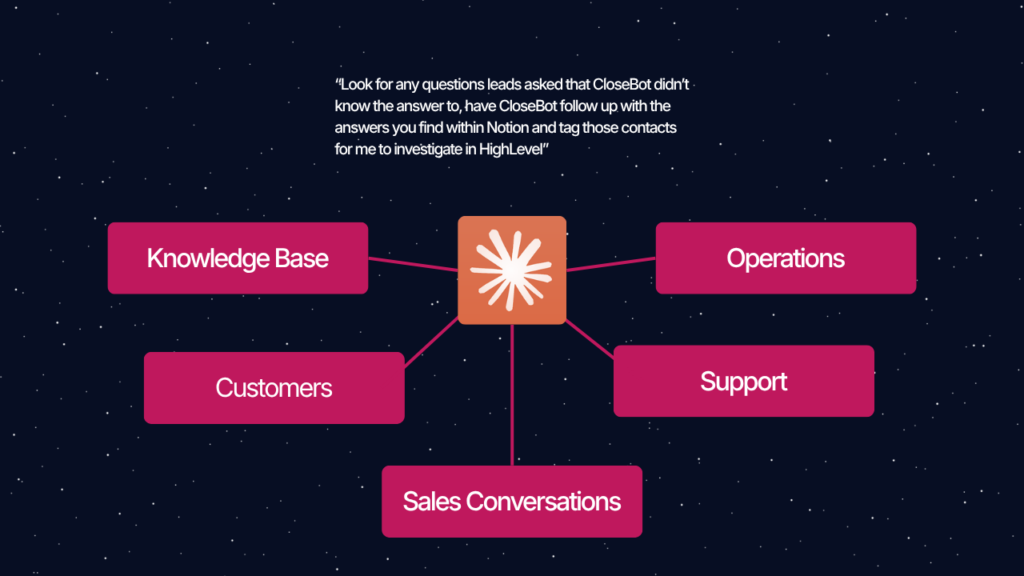
There's also a third pattern that's newer and worth knowing about: your knowledge base as AI fuel. The documentation you write for humans is increasingly readable by the AI tools in your stack. CloseBot, for instance, can read from Notion as a knowledge base meaning the sales AI answering your leads' questions can pull from the same LIVE documents your team maintains about a client's offer, pricing structure, and FAQs. Update the Notion page, and the AI's answers update with it.
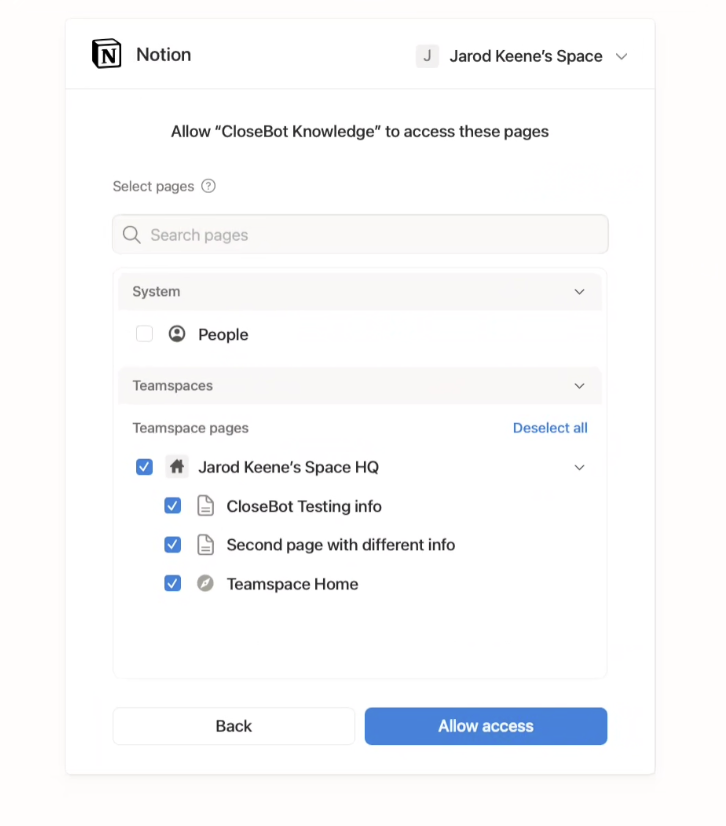
This happens live. No manual re-sync button.
Write documentation once, have both humans and AI use it. This trend for agencies is becoming one of the strongest arguments for keeping your knowledge base clean and current.
5. ClickUp - Operations
Where your team lives, communicates and plans and tracks projects.
Here's a stack-design principle that took a lot of agencies too long to learn: keep your internal operations separate from your client-facing systems.
Can you handle internal team communications within your CRM like HighLevel? Yes... Should you do this? Absolutely not.
Your clients live in HighLevel... that's where their campaigns, contacts, and communication happen. But your team's work... task assignments, fulfillment pipelines, sprint planning, the internal conversation about why a deliverable is late should live somewhere your clients aren't. Mixing the two leads to awkward moments and messy permissions.
ClickUp is built for exactly this internal layer. Task management, docs, goals, timelines, and team chat in one place, with enough flexibility to model whatever your fulfillment process looks like. Its AI features handle the administrative overhead that eats team time: summarizing long task threads, generating standup reports, drafting task descriptions, and answering "what's the status of X?" questions from your workspace data.
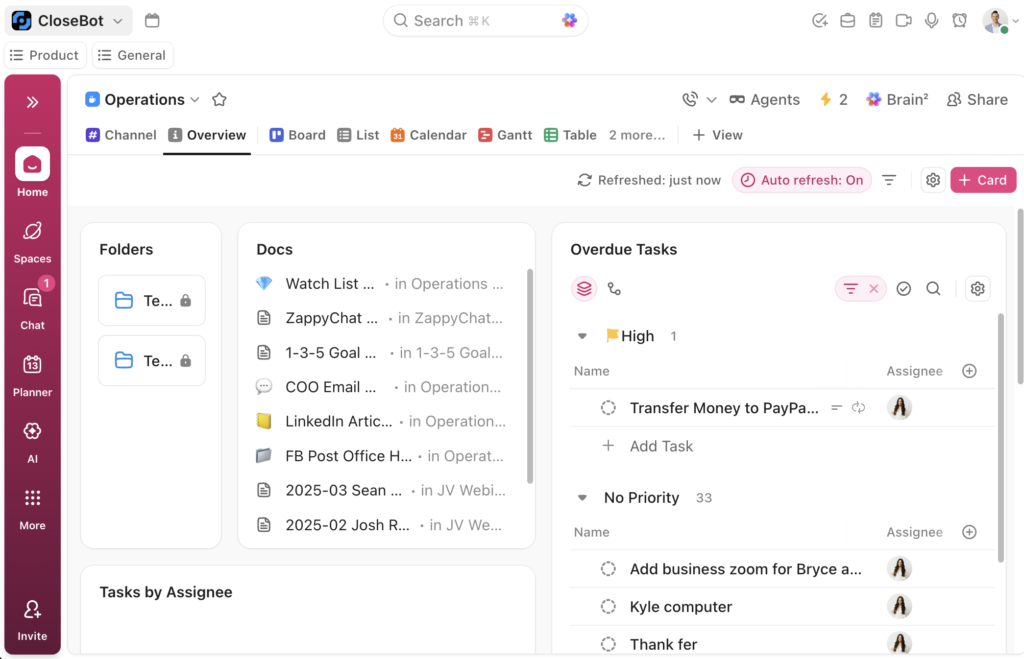
For a typical agency, the pattern looks like: every new client triggers an onboarding project in ClickUp, fulfillment work is tracked as tasks with clear owners, and weekly priorities are visible to everyone without a status meeting. It's not glamorous, but operational clarity is usually what separates agencies that scale from agencies that plateau at the founder's capacity.
And if you'd rather not build those workflows by hand this is exactly the kind of cross-tool automation Claude Code handles well.
6. Intercom - Support
Support tickets, help center, and an AI agent that resolves common questions before they reach a human.
As your agency grows, especially if you've white-labeled software or sell a productized service, support becomes its own workload. Clients have questions. Their staff have questions. Things break at 9pm.
Intercom is the strongest option for this job. It combines a shared inbox, ticket management, a help center, and Fin, its AI support agent, which answers questions directly from your documentation and resolves a substantial share of routine inquiries without human involvement. For an agency, that means your team handles the genuinely hard problems while the AI absorbs the "how do I log in?" tier.
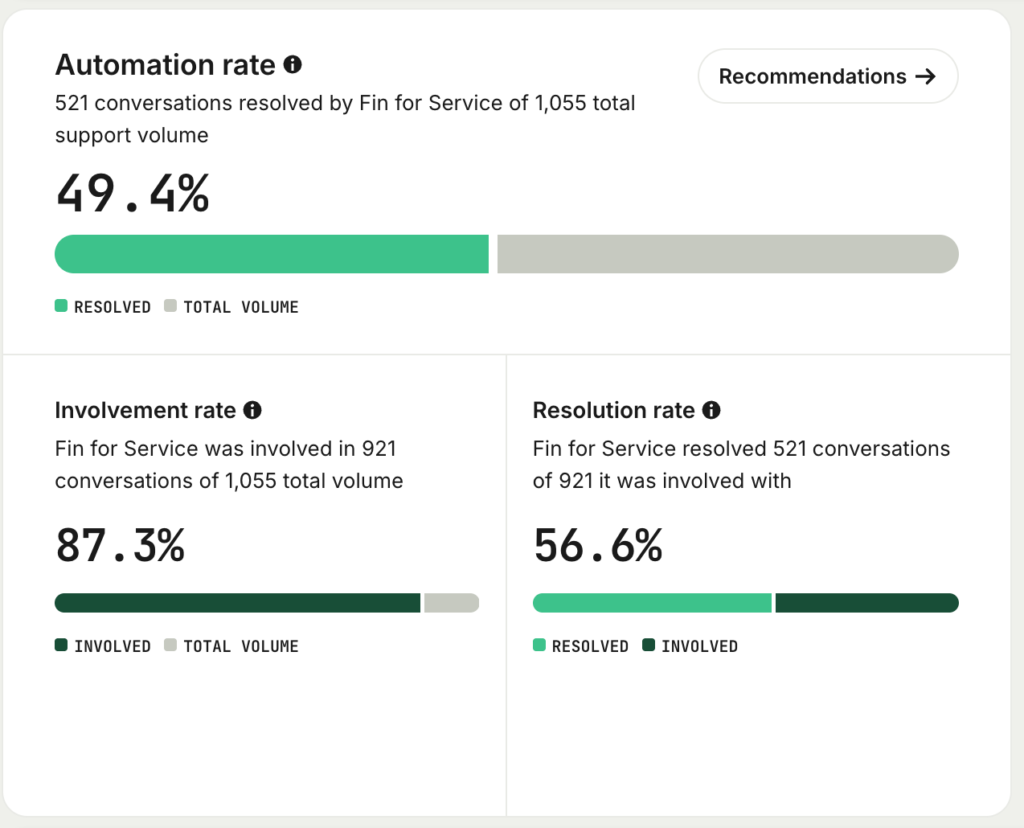
It's worth pausing on a distinction here, because it trips people up: support AI and sales AI are different specialties, even though both are "AI that chats."
Support AI, like Intercom's Fin, is optimized to resolve and deflect... its job is to answer accurately from documentation and close the loop quickly. Success looks like a satisfied user who didn't need a human.
Sales AI, like CloseBot, is optimized to qualify and convert. Its job is to keep a conversation moving toward a booked appointment, handle objections, and know when to push and when to back off. Success looks like a calendar filling up.
Pointing a support bot at your inbound leads gives you polite, accurate answers and very few booked calls. Pointing a sales bot at your support queue frustrates customers who just want help. Most growing agencies eventually run both, aimed at different doors.
How the Stack Fits Together
Individually, each of these tools is good. The real leverage is in how they connect:
- Leads come into HighLevel → your CRM captures and organizes everything.
- CloseBot engages instantly → qualifying leads and booking appointments over messaging in HighLevel, HubSpot or standalone, drawing on knowledge from sources like Notion
- ClickUp runs fulfillment → internal tasks, projects, and team coordination, away from client eyes.
- Intercom handles support → tickets and front-line questions, resolved by AI where possible.
- Claude Code connects it all → automating the reporting, data movement, and technical work between systems.
You don't need all six on day one. Most agencies start with the CRM, add conversational AI when speed-to-lead becomes the bottleneck, and layer in the operational tools as the team grows. But it's useful to know what the mature version of the stack looks like, so each tool you add is a step toward it rather than a subscription you'll cancel in three months.
The agencies winning with AI in 2026 are the ones with the right tools. The ones with the clearest division of labor. One tool for sales conversations. One for client management. One for knowledge. One for internal ops. One for support. And one assistant orchestrating across all of it.
FAQ
It depends on the job. For sales conversations and appointment booking, a dedicated conversational AI like CloseBot. For client management, HighLevel. For technical automation, Claude Code. For knowledge, operations, and support: Notion, ClickUp, and Intercom respectively. Beware of any single tool claiming to do all six jobs well.
Yes, this is one of the most proven AI use cases in the agency space. Conversational AI handles two-way conversations with leads, qualifies them against your criteria, and books directly onto calendars. The key variables to evaluate are setup time per client, uptime, and how pricing behaves as you add subaccounts.
Generally, yes. Sales AI is optimized to qualify leads and drive toward booked appointments; support AI is optimized to resolve questions from documentation. They're trained for different outcomes, and using one for the other's job produces mediocre results in both directions.
No, but they change what your team spends time on. The pattern across all six tools here is the same: AI absorbs the repetitive layer (first responses, routine tickets, status updates, glue work) so your people spend time on strategy, relationships, and the judgment calls AI can't make.