
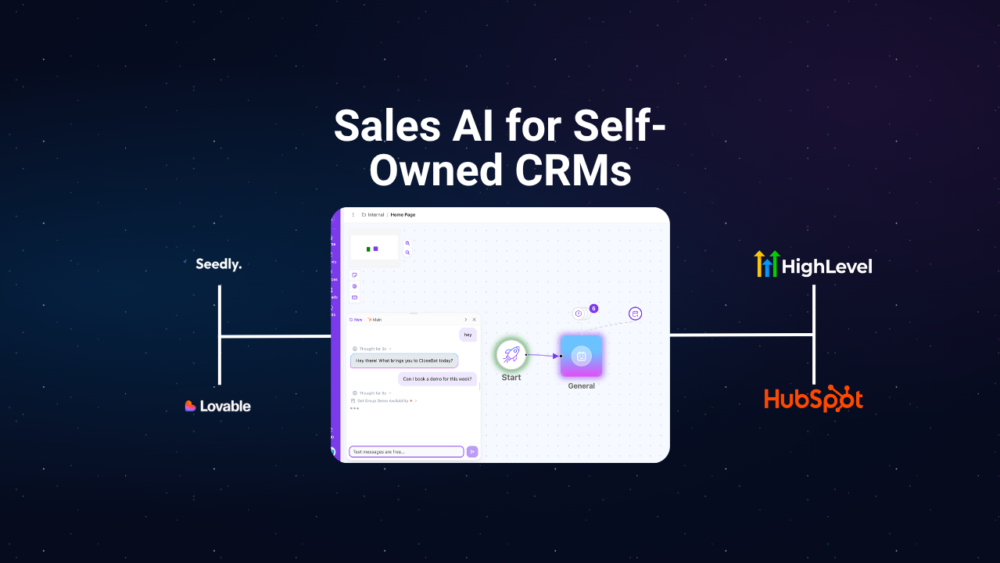
On the surface CRMs seem simple. You have contacts, you have fields, you have chat channels. Usually there’s more to it, especially for agency owners white labeling software like HighLevel, which includes community features, calendars, task management and so much more.
Until lately, if you wanted a CRM, the only option was to rent one. Pay the monthly fee. Live by their rules.
Vibe coding recently changed that. With plain english, anyone can get websites and apps to appear on screen. Real, functional apps. Companies like Seedly CRM are even popping up, giving you deploy-ready code to help you get started with a strong foundation.
So what does this mean for the future of software? What parts should be vibe coded? Is the future 100% owned instead of rented?
The Own-Your-CRM Movement (and What “Shallow” Actually Means)
Let’s be honest about something the SaaS industry doesn’t want you to say out loud… most of the features in your CRM are dead weight. You’re paying a premium every month for 200 modules so you can use 12.
Some CRMs build shallow, spending 10% of their time building things you care about, 90% of their time building things for the rest of their users or just to check a box that makes them stand out against a competitor.
Other CRMs seem never to have updates at all.
The own-your-CRM movement flips that. Platforms like Seedly ship with everything an agency genuinely needs… contacts, pipelines, a unified inbox for email/SMS/Facebook/Instagram, workflow automation, forms, booking, invoicing, e-signatures and reporting. The features are intentionally shallow but complete. Wide enough to run a real business, deliberately not deep enough to compete with category leaders on every single sub-feature.
That’s deliberate. The moment a CRM tries to be everything at once it stops being the best at anything.
Then when you turn around to sell this solution to businesses who care about a single feature category, they are left unimpressed when they find out how little capability that single feature need has.
Whether you’re in a CRM that has open code that allows you to integrate with other tools for depth, or one with a solid marketplace, it’s important not to lock yourself into a shallow CRM with no options.
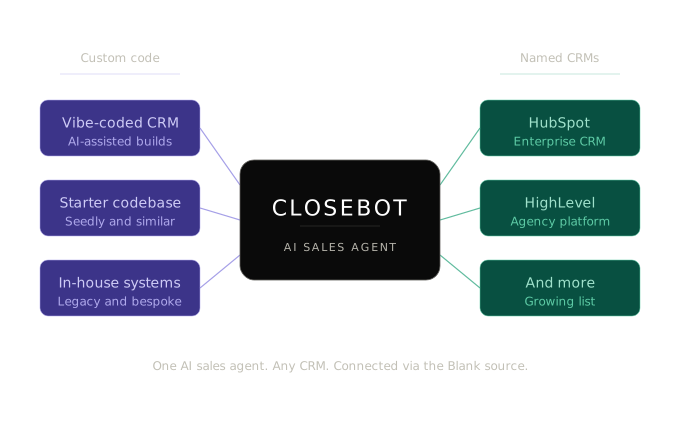
CloseBot is one of the top marketplace apps for HighLevel even though they have their own shallow version of Conversational Sales Agents. CloseBot is also easily integrated with Seedly CRM code owners. Learn how to integrate here.
AI Sales Agents… Depth Matters
Here’s where the trade-off gets practical.
Customer conversations are not the place to settle for shallow. Whether a lead came from a Facebook ad, a Google form, a referral text, or a DM… the next 5 minutes decide whether they become a booked appointment or a cold lead.
CloseBot has been optimizing our agents for conversions for 3 years based off of real data. We’ve seen what works. Seen what doesn’t. And the agents have been tweaked thousands of times accordingly.
The result means 2-3x better conversions than homegrown systems built off of your own assumptions. And best practices are constantly changing.
Sales AI is not a feature like contact records and fields, which don’t change at all. Best practices around conversational AI change constantly… and you can’t be the one to manage those iterations without the data to back up your decisions.
If your AI lead generation chatbot is a 6/10 vs. a 10/10, that will sink your business. That’s why the smart move is to keep the CRM ownership-first and let a dedicated tool handle the AI layer.
What the Owned + CloseBot Integration Actually Looks Like
Whether you’ve build it from scratch or using Seedly, you likely have some kind of inbox… email, SMS, Facebook, and Instagram, all threaded into a single conversation view tied to each contact.
With CloseBot integrated, those same channels now have a 24/7 AI appointment setter operating inside them. When a new lead lands in Seedly from a form, a CSV import, a workflow trigger, or a paid campaign, CloseBot can immediately take the wheel:
- Open a personalized conversation in the channel the lead actually uses
- Qualify them against your real ICP, not a generic script
- Handle objections, answer questions, and ask the follow-up questions a tired human would forget
- Book the appointment directly onto your team’s calendar
- Hand the conversation off to a human the moment things go off-script
And critically, all of it stays inside your inbox. Your reps see every message, every nudge, every booking. Nothing happens in a black box. Conversation logs are fully transparent, and so are the prompts driving them — which matters a lot when you’re tuning an AI sales agent for a real client.
For agencies running Seedly across multiple client deployments, this is the unlock: you ship your client a CRM they own, with an AI sales agent layered into the channels they already use, and you keep ownership of both the data and the conversation strategy.
The “Blank” Source: Why This Pattern Works With Anything
Here’s the part that should make every builder pay attention.
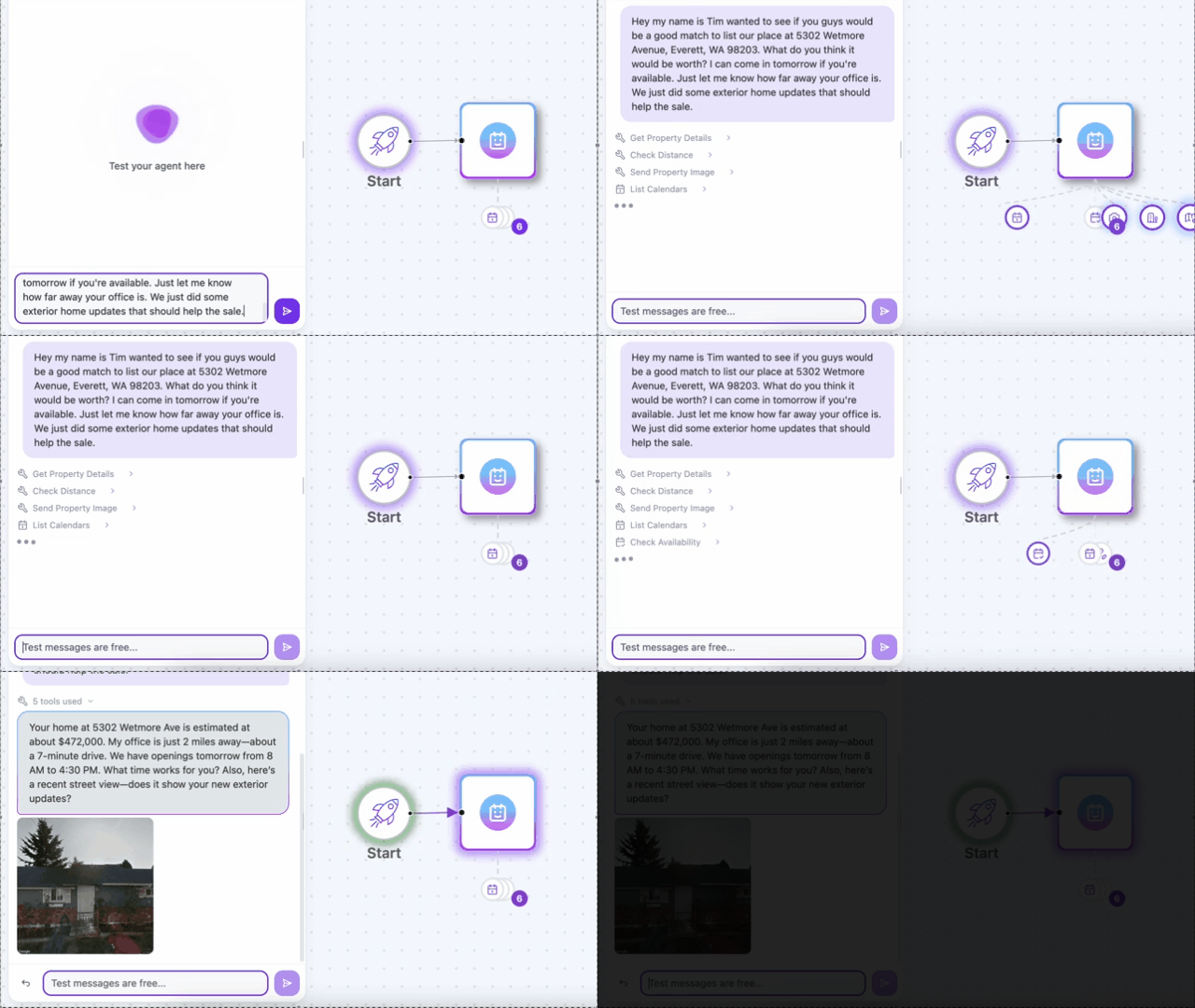
CloseBot doesn’t just integrate with the big-name CRMs (HubSpot, HighLevel, etc.). Through what we call the Blank source, CloseBot can plug into any system… including the one you just built last weekend.
- A CRM you bought the starter code for (like Seedly, or anything similar)
- A CRM you vibe-coded in a few evenings on top of Next.js and Supabase
- A legacy in-house system that your operations team is still running on
- A category-leading SaaS CRM like HighLevel or HubSpot where you want stronger AI than the built-in version
- A bespoke vertical CRM built specifically for healthcare, real estate, fitness, home services, or any other niche
The Blank source treats CloseBot as the AI conversation layer for whatever system already holds your contacts and channels. You wire up the inbound (new lead arrived) and the outbound (send this message, book this calendar event), and CloseBot handles everything in between.
This is the connective tissue the new CRM frontier needs. Because if owning your CRM means you also have to build your own automated lead follow up system, your own AI sales agent, and knowledge base, you’re going to lose enough sales to drive you and your clients out of business.
That $400 monthly you saved in subscriptions is traded for a $400 monthly hosting bill and 20% drop in sales conversions
The pattern that actually scales… own the foundation, integrate the specialty. Shallow at the core… integrated depth in the areas you care about.
Build, Buy, or Integrate? It’s Probably All Three
Should we build it, or should we buy it?
The real answer for almost every modern stack is now:
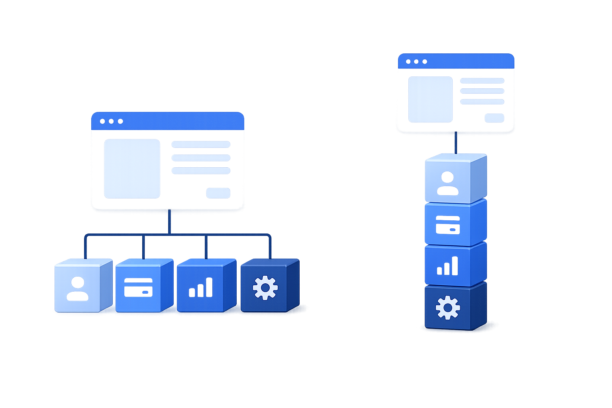
- Build the things that are uniquely yours and rarely change (your pipeline structure, your custom fields, your branding, your internal workflows)
- Buy the foundations that everyone needs and nobody wants to maintain (a CRM, an email engine, a calendar system, a billing engine)
- Integrate specialty depth where the category itself moves fast and quality matters disproportionately (AI sales agents, payment processing, deliverability infrastructure, analytics)
Whether you eventually deploy this on your own custom solution, on a CRM you assembled yourself with AI coding tools, or on top of HighLevel or HubSpot, the principle holds. Pick a foundation you can live with. Integrate depth where shallow won’t cut it. And don’t let any single vendor convince you that the entire stack has to come from them. Because they simply cannot keep up.
The Takeaway for Agency Owners
If you’ve been on the SaaS treadmill long enough to remember when your “lifetime” plan got grandfathered into a price hike, you already know where this is going. The next decade of agency tech is going to look a lot less like a single bloated platform and a lot more like an opinionated foundation surrounded by a small handful of deeply integrated specialty tools.
- You can own your CRM. No subscription, no per-seat tax, no waiting on someone else’s roadmap.
- You can keep your AI sales agent best-in-class. No settling for a checkbox feature inside a sprawling suite.
- You can connect them through a flexible integration layer that doesn’t care whether your backend is a polished product, a starter kit, or something you built yourself.
The companies that figure this out first are going to ship faster, run leaner, and keep more margin on every client they serve.Self